HazMat Drivers Training

Enter your DOT Number Below

HazMat Drivers Training

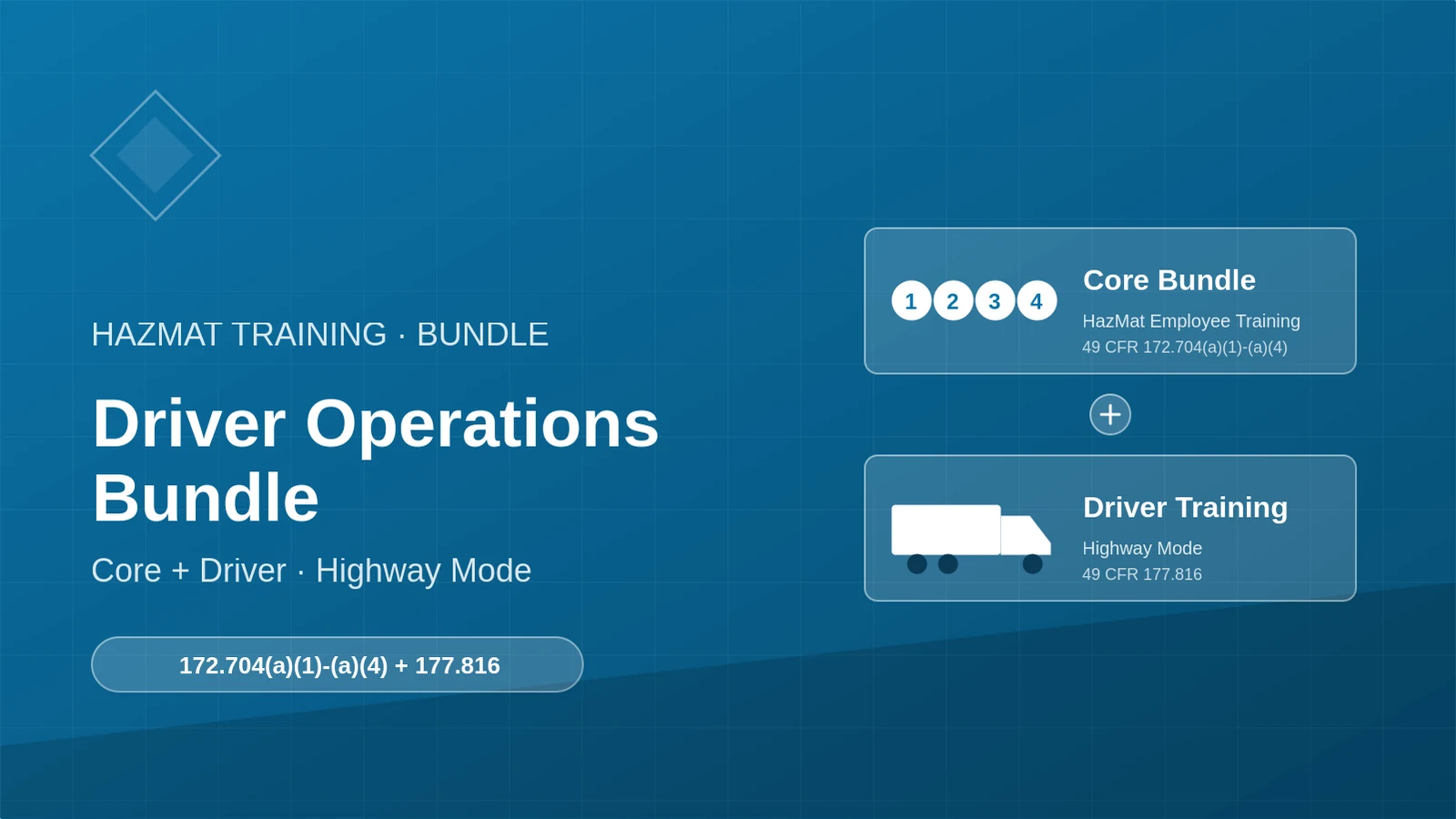
Everything a hazmat driver’s employer must document, in one enrollment per driver: the four 49 CFR 172.704 subjects (general awareness, function-specific, safety, security awareness) plus the 49 CFR 177.816 driver subjects. Two courses, a graded knowledge check on each, a certificate for each. Recurrent at least every three years. $199.00 per driver.

HazMat Drivers Training

$199.00 / Participant

Everything a hazmat driver’s employer must document, in one enrollment per driver: the four 49 CFR 172.704 subjects (general awareness, function-specific, safety, security awareness) plus the 49 CFR 177.816 driver subjects. Two courses, a graded knowledge check on each, a certificate for each. Recurrent at least every three years. $199.00 per driver.

- +

Questions? Call (307) 200-8338, Mon-Fri 7am–7pm CT.

In short: a hazmat driver needs two layers of training. 49 CFR 172.704 requires every hazmat employee, drivers included, to be trained in general awareness, function-specific, safety, and security awareness subjects; 49 CFR 177.816 adds, “in addition to” that, the driver subjects: pre-trip inspection, vehicle controls and emergency equipment, safe operation, tunnels, bridges and rail crossings, the Part 397 attendance, parking, routing and incident rules, and loading and unloading. This course delivers both layers in one enrollment per driver, with a graded knowledge check on each course and the certificates the employer files under 49 CFR 172.704(d). Initial training within 90 days of starting, recurrent at least every three years. $199.00 per driver.

HazMat Drivers Training

HazMat Drivers Training: the 172.704 subjects plus the 177.816 driver subjects

For drivers who haul hazardous materials by highway. One enrollment per driver covers everything the rule asks of a hazmat employee who drives, for a carrier that is not required to keep a written security plan.

Program Overview

A driver who transports hazardous materials is a hazmat employee under 49 CFR 171.8, so the whole of 49 CFR 172.704 applies to that driver, and 49 CFR 177.800(c) says a carrier may not transport hazmat by motor vehicle unless each hazmat employee involved is trained as required by Part 177 and by subpart H of Part 172. 49 CFR 177.816 then adds the driver subjects on top. A CDL hazmat or tank endorsement can stand in for the 177.816 subjects, never for the 172.704 set; that duty stays with the employer.
This program enrolls each driver in two courses, taken in order:

Course 1: HazMat Employee Training (49 CFR 172.704(a)(1) to (a)(4))

  • General awareness and familiarization: the Hazardous Materials Regulations, hazard classes, and how to recognize and identify hazmat.
  • Function-specific training: the shipping papers, marks, labels, placards, packaging and loading rules that the driver’s own functions touch.
  • Safety training: emergency response information, the hazards of the materials handled, and how to protect oneself.
  • Security awareness: the security risks of hazmat transportation and how to recognize and respond to a possible threat.

Four modules, about six hours of video, a graded knowledge check after each module.

Course 2: HazMat Driver Training (49 CFR 177.816)

  • Pre-trip safety inspection; vehicle controls and equipment, including emergency equipment.
  • Operation of the vehicle: turning, braking, parking; tunnels, bridges and railroad crossings.
  • The Part 397 rules: attendance of vehicles, parking, smoking, routing, and incident reporting.
  • Loading and unloading, including compatibility and segregation, and the cargo tank and portable tank subjects of 177.816(b) for the drivers who need them.

About 1.5 hours of video with a graded knowledge check.

Certificates and records

Each course issues its own certificate of completion, so the driver’s file holds the 172.704 record and the 177.816 record separately, the way the rule keeps them. The employer certifies and records the training under 49 CFR 172.704(d): employee name, completion date, a description of the materials, the trainer’s name and address, and the certification, kept for as long as the person is a hazmat employee plus 90 days.

Who takes what

  • Drivers, no written security plan at the company: this course.
  • Drivers at a company that must keep a written security plan under 49 CFR 172.800: the HazMat Complete Training Program, which adds in-depth security.
  • Loaders, packagers, dispatchers and office staff who do not drive: HazMat Employee Training (Non-Drivers), or HazMat In-Depth Security Training where a security plan applies.

Related: Hazmat employee training under 49 CFR 172.704 · Hazmat registration, permits and training: 2026 guide · Does a CDL hazmat endorsement satisfy 172.704? · When must a new hazmat employee be trained? ·
How long is the hazmat certificate valid? · Lithium battery shipping training

Frequently
Asked Questions.

§177.816 driver-specific training is in addition to the four §172.704(a)(1) to (a)(4) categories, which HazMat Drivers Training also delivers. This course covers the operational driver duties: shipping papers in the cab (§177.817), pre-trip and en-route inspection, Part 397 driving and parking rules (current §397.17 tire-inspection rule, not the obsolete 100-mile rule), §177.834 cargo handling, §177.848 segregation, §171.15 incident notification, and the §171.16 30-day Form DOT F 5800.1 report.

It satisfies the §177.816(a) driver training requirement. If you drive a cargo tank ≥1,000 gallons, you ALSO need §177.816(b) specialized cargo-tank training, which is delivered separately by your employer or a specialized provider. The course explains where the line falls.

The current §397.17 rule requires drivers of vehicles transporting hazardous materials to examine each tire at the beginning of each trip AND each time the vehicle is parked. The old 100-mile-or-2-hour rule is obsolete. The Part 397 Cheat Sheet (downloadable) summarizes the current rule alongside §397.5 attendance, §397.7 parking, §397.13 smoking, §397.15 fueling, and §397.19 explosives instructions.

Additional Part 397 requirements apply, including §397.19 written instructions and route restrictions. Your shipper must provide written copies of the rules in §177.835 and accident-or-delay instructions. The course covers what to expect; carrier-specific procedures may add to this.

Security awareness (§172.704(a)(4)) is one of the four categories in HazMat Drivers Training. If your carrier is subject to a §172.800 written security plan, your drivers take the HazMat Complete Training Program instead, which adds in-depth security training (§172.704(a)(5)) on your own plan.

Three downloads: the Hazmat Pre-Trip Inspection Checklist, the In-Transit Incident Response Quick Reference Card, and the Part 397 Driving Rules Cheat Sheet. All are designed to live in the cab or with the day’s paperwork.

Because In-Depth Security training under §172.704(a)(5) is required ONLY for hazmat employees of companies subject to a §172.800 written security plan — and most hazmat employers are not. If your operation is not subject to §172.800, paying for In-Depth Security adds cost without compliance value. This bundle covers everything those operations need.

If your company has a written §172.800 security plan, or you’re not sure, download the §172.800(a) Self-Assessment Worksheet from the In-Depth Security product page. It walks the three-question gate and points you to the right bundle.

Yes for §172.704(a)(1)–(a)(4) and §177.816(a). Cargo-tank drivers (≥1,000 gallons) also need §177.816(b) specialized training, which your carrier provides separately.

Every three years per §172.704(c)(2). The bundle is the same content recurrent learners can take — and the LMS will track your next-due date.

DotMotusCompliance Services
HazMat Driver Operations Bundle — Core + Driver — Highway ModeHazMat Drivers Training
$199.00 / ParticipantEnroll Now
Scroll to Top