Do I Need a UCR Registration? A Self-Check by Business Type
You need UCR registration if your business touches interstate or international freight or passengers and is a motor carrier, private carrier of property, broker, freight forwarder or leasing company. Truck weight, trip frequency and your home state change what you pay or where you pay, not whether you pay.
Most UCR articles explain the rules and leave you to apply them. This one works the other way: start from what your business actually does, follow the flowchart or find your trade in the table, and you will have an answer in about two minutes. If the answer is yes, our UCR filing guide for 2027 walks through fees and the filing screens.
The 2-minute decision flow
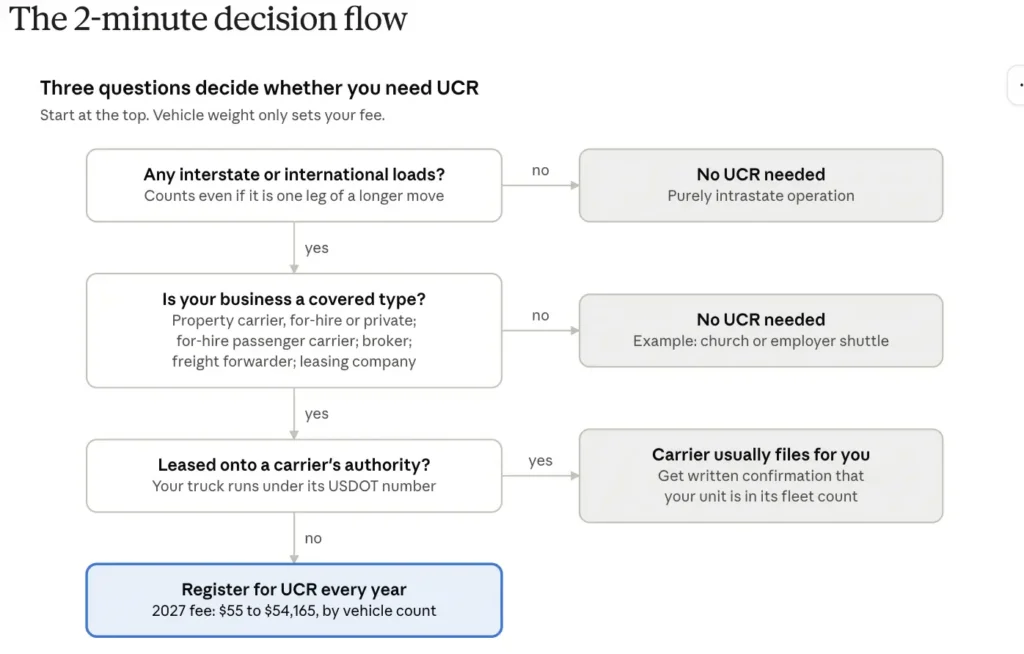
Answer each question for the past 12 months and the year ahead. If any “no” feels uncertain, treat it as a “maybe” and confirm with the UCR Plan’s free questionnaire.
Find your business
Most people searching this question are not trucking companies in the traditional sense. Find the row closest to your operation.
| Your business | Typical setup | Need UCR? | The deciding detail |
|---|---|---|---|
| Hotshot hauler | One-ton pickup + gooseneck, own authority | Yes | Truck + trailer rating is usually over 10,001 lbs combined |
| Box truck / final-mile delivery | 16–26 ft box trucks crossing a state line | Yes | 26,000 lbs is a CDL line, not a UCR line |
| Cargo van courier | Sprinter-type vans under 10,001 lbs, own MC authority | Usually yes | The UCR Plan says light vehicles lower your fee but do not exempt you |
| Construction contractor | Hauls own excavator to job sites in two states | Yes | You are a private carrier of property, even though you are not paid to haul |
| Landscaper or tradesperson | Dump truck or trailer rig, jobs across a state line | Yes, if 10,001+ lbs | Same private-carrier logic as the contractor |
| Household moving company | Interstate moves | Yes | For-hire carrier of property |
| Charter or tour bus company | Paid group trips across state lines | Yes | For-hire carriers of passengers are covered |
| Church, school or employer shuttle | Moves its own people, not for hire | No | Private carriers of passengers are exempt |
| Freight broker | No trucks | Yes | Pays the lowest bracket |
| Truck and trailer leasing company | Leases units to carriers | Yes | Leasing companies are a named category |
| Leased owner-operator | Runs under another carrier’s authority | Depends | See the owner-operator section below |
| Local hauler, one state only | Freight starts and ends in-state | No | Unless the load is part of a longer interstate move |
| Canadian or Mexican carrier | Runs loads into the US | Yes | Registers through an assigned base state |
If your business does two things, such as brokering loads and running two of its own trucks, you register once under your USDOT number and pay a single fee.
The three tests, and the myth behind each
Every UCR answer comes from three tests. Each one has a popular shortcut that gives the wrong answer.
Test 1: Is it interstate commerce?
Myth: “I only cross the state line a few times a year, so it doesn’t count.”
Reality: Frequency does not matter. One interstate load in a year is interstate commerce. So is an in-state haul when the freight came from, or is headed to, another state or country, such as a container moving from a port to a nearby warehouse.
Ask yourself: Did any load I carried, or arranged, start or end outside my state?
Test 2: Is my business a covered type?
Myth: “I’m not a trucking company. I just haul my own stuff.”
Reality: Hauling your own goods or equipment for your business makes you a motor private carrier of property, which is covered. The only carrier type left out is the private carrier of passengers.
Ask yourself: Am I moving freight (mine or anyone’s), arranging freight, or leasing vehicles to people who do?
Test 3: What vehicles do I run?
Myth: “My trucks are under 26,000 lbs, so I’m exempt.”
Reality: The UCR vehicle line is 10,001 lbs GVWR or GCWR, 11+ passengers including the driver, or placarded hazmat at any weight. And per the UCR Plan, a business that runs only lighter vehicles still registers if it is otherwise covered; it simply lands in the lowest bracket.
Ask yourself: How many qualifying power units do I run? The answer sets my fee bracket; it almost never decides whether I file.
Two more myths worth killing
- “I have a USDOT number, so I’m covered.” Your USDOT number identifies you. UCR is a separate annual payment in a separate system.
- “My state doesn’t participate, so it doesn’t apply.” Businesses in Arizona, Florida, Hawaii, Maryland, Nevada, New Jersey, Oregon, Vermont, Wyoming and Washington, D.C. still register, through a participating base state.
Leased owner-operators: get the answer in writing
If you run under your own authority, you register. If you are leased onto a carrier and haul under their authority, the carrier normally files and counts your truck in its fleet. The risk is in the gap: you assume they counted you, they assume you filed.
An officer checks the USDOT number on the truck. If that number belongs to the carrier and the carrier is registered, you are fine. If your own number is on the door, or your authority is still active, your own status may be checked.
Send your carrier a short message like this and keep the reply:
Hi [name], I’m leased to [carrier] under [lease number], running unit [truck number]. Can you confirm in writing that this unit is included in [carrier]’s 2027 UCR fleet count, and that [carrier] has filed or will file 2027 UCR before January 1, 2027? Thanks.
If you hold your own MC authority that you are not using, decide whether to keep it. Active authority with no UCR can create problems even while you drive for someone else.
Just realized you should have been filing?
It is common, especially for contractors and van operators who never thought of themselves as carriers. Here is how to get current:
- Confirm it first. Run the free “Do I Need to Register?” questionnaire on the UCR Plan site. Two minutes, no cost.
- Check which years show unpaid. Search your USDOT number on ucr.gov. Each year is separate.
- File the current year first. For most readers today, that means 2026, which is still enforced through December 31, 2026. Then file 2027 before January 1, 2027.
- Pay each year at its own fee. A missed 2026 registration costs the 2026 amount, not the 2027 amount.
- Fix your records. If your MCS-150 lists the wrong operation type or vehicle count, update it with FMCSA so next year starts clean.
Penalties for unregistered operation are set by each state and vary. Registering before a roadside stop is almost always cheaper than registering after one.
Signs you may be out of compliance
- You got a letter or citation mentioning UCR.
- A shipper or broker asked for your UCR status and you were not sure.
- You have a USDOT number marked interstate but have never paid UCR.
- You added a heavier truck or trailer this year.
Quick questions
Do I need UCR for a pickup and trailer? If the combined rating is 10,001 lbs or more and you haul interstate, yes. Many hotshot setups qualify.
Does a farm or contractor hauling its own equipment need UCR? If it crosses state lines with qualifying vehicles, it is a private carrier of property and is covered. Run the official questionnaire if you are unsure about a special exemption.
Do rideshare or limo drivers need UCR? A standard car or SUV seats fewer than 11, so it is not a UCR vehicle. Larger for-hire passenger vans and buses crossing state lines are covered.
I only drive in-state, but my customer ships out of state. Do I need it? Possibly. If your load is one leg of a longer interstate move, it can count as interstate commerce.
Can a filing service tell me if I need UCR? Yes, but the UCR Plan’s questionnaire gives the same answer free.
What does UCR cost if I do need it? $55 for 2027 at the smallest size. See the full fee table in our 2027 UCR filing guide.
About this guide
DotMotusCompliance is a private compliance assistance company, not FMCSA, USDOT, the UCR Plan or a government agency. You can always check eligibility free and register directly at ucr.gov. If you would rather have us confirm your classification and file for you, see our 2027 UCR registration service or call (307) 200-8338, Monday–Friday, 7 AM–7 PM Central.