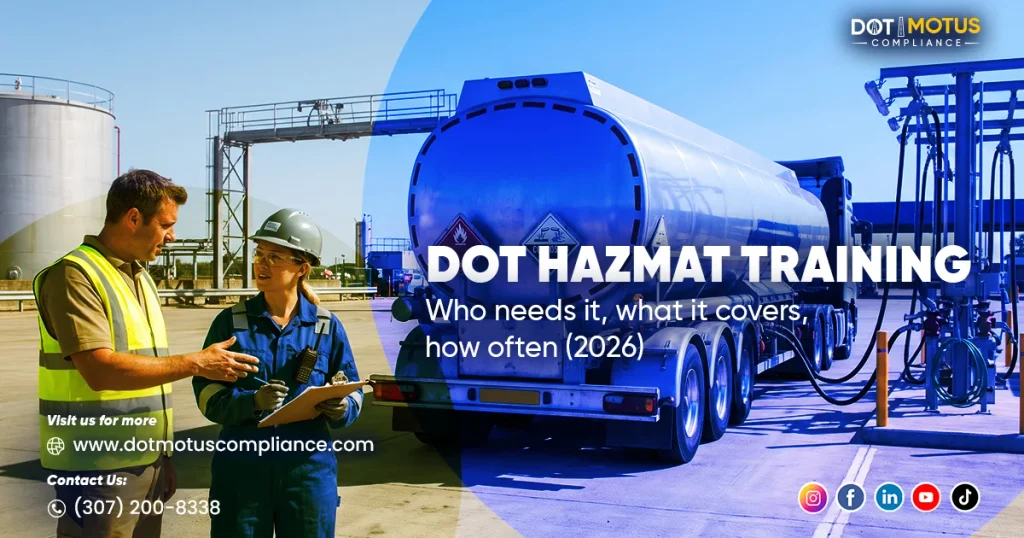
DOT hazmat training is the training federal law requires for anyone whose job touches hazardous materials in transport: drivers, loaders, packers, shipping clerks and the people who supervise them. Under 49 CFR 172.704, every hazmat employee needs general awareness, function-specific, safety and security awareness training, plus in-depth security training if the company needs a security plan and driver training if they drive. The employer must train, test, certify and keep records, and the training must be repeated at least every three years.
Quick answer
| Question | Answer |
| Who regulates it? | The Pipeline and Hazardous Materials Safety Administration (PHMSA), part of the U.S. Department of Transportation (DOT) |
| Main rule | 49 CFR Part 172, Subpart H (sections 172.700–172.704) |
| Who needs it? | Every “hazmat employee”: anyone who loads, unloads, handles, packs, labels, prepares paperwork for or transports hazmat, including self-employed owner-operators |
| What’s required? | General awareness, function-specific, safety and security awareness training. Plus in-depth security (if a security plan is required) and driver training (if they drive) |
| New employees | May work under direct supervision of a trained employee, but must finish training within 90 days |
| How often? | At least once every 3 years |
| Who provides it? | The hazmat employer must make sure it happens: train, test, certify and keep records |
| Can it be online? | Yes, as long as the employee is also tested and the employer certifies the training |
In this guide
- What is hazmat?
- What is DOT hazmat training?
- Who needs DOT hazmat training?
- The 5 types of required hazmat training
- Which training is not required by DOT?
- How often is hazmat training required?
- Hazmat training certificates and records
- How to set up hazmat training, step by step
- Myths and mistakes
- Hazmat training checklist
- Which DOT hazmat training course fits each job?
- FAQ
What is hazmat?
“Hazmat” is short for hazardous materials: substances that can harm people, property or the environment if they leak, burn or react during transport. DOT sorts them into nine hazard classes.
| Class | What it covers | Everyday examples |
| 1 | Explosives | Fireworks, ammunition |
| 2 | Gases | Propane, aerosol cans, oxygen |
| 3 | Flammable liquids | Gasoline, diesel, paint |
| 4 | Flammable solids | Matches, some metal powders |
| 5 | Oxidizers and organic peroxides | Pool chlorine, some fertilizers |
| 6 | Toxic and infectious substances | Pesticides, medical samples |
| 7 | Radioactive materials | Some medical and industrial sources |
| 8 | Corrosives | Battery acid, drain cleaners |
| 9 | Miscellaneous | Lithium batteries, dry ice |
Key point: Many everyday products count as hazmat in transport. If your business ships paint, batteries, cleaning chemicals or fuel, someone in your company is probably a hazmat employee.
What is DOT hazmat training?
DOT hazmat training is the training required by the Hazardous Materials Regulations (HMR) for people who prepare, handle or move hazmat. It’s sometimes called hazardous material training or DOT hazmat transportation training.
The goal is simple: to make sure each person knows the rules for their own job, can recognize hazmat, and knows what to do if something goes wrong. PHMSA says the law “requires the training of ALL hazmat employees” (PHMSA).
DOT hazmat training is about transportation. Workplace chemical safety and emergency cleanup fall under different OSHA rules. We explain the difference in HAZWOPER vs. DOT hazmat training.
Who needs DOT hazmat training?
Anyone who is a hazmat employee. PHMSA describes a hazmat employee as a person who, as part of their job, directly affects hazmat transportation safety (PHMSA training requirements guide). That includes anyone who:
- Loads, unloads or handles hazmat
- Prepares hazmat for shipping: classifying, packaging, marking, labeling
- Fills out shipping papers or placards a load
- Designs, makes, tests or repairs packagings sold for hazmat
- Drives a vehicle carrying hazmat
- Is responsible for the safety of hazmat in transport, including supervisors
It also includes self-employed owner-operators who haul hazmat.
| Job role | Hazmat employee? | Training they need |
| Tanker or placarded-load driver | Yes | All four core types + driver training |
| Dock worker loading hazmat | Yes | All four core types |
| Shipping clerk preparing shipping papers | Yes | All four core types |
| Dispatcher who decides how hazmat is loaded or routed | Usually yes | All four core types |
| Supervisor who directs hazmat work | Yes | All four core types |
| Office staff who never touch hazmat or its paperwork | No | None under DOT |
Non-drivers make up a large share of hazmat employees. See hazmat training for non-drivers for those roles in detail.
Example: Say you run a small fuel delivery company with two drivers and one yard worker who fills the tanks. All three are hazmat employees. The drivers need the four core types plus driver training; the yard worker needs the four core types.
The 5 types of required hazmat training
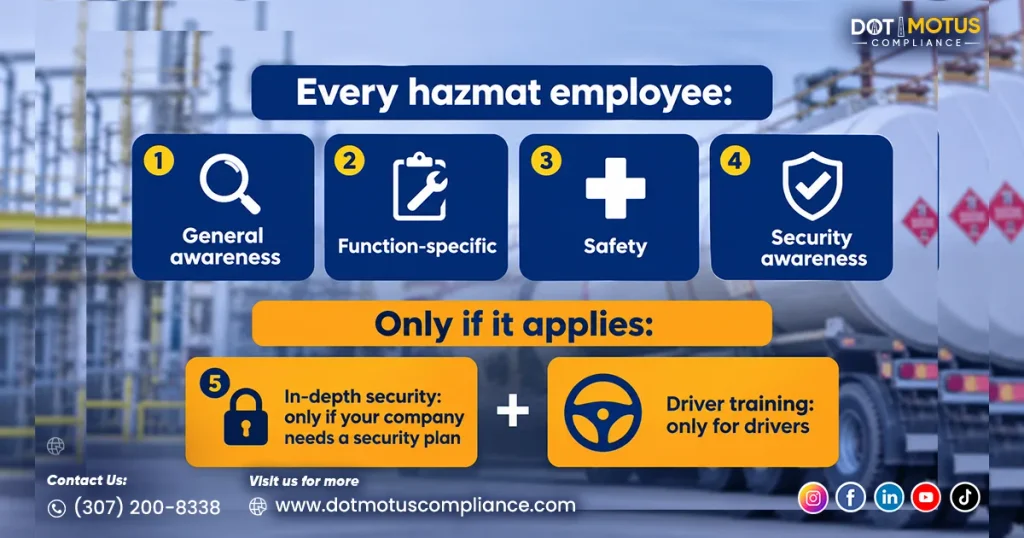
People often ask “what are the three training requirements for hazmat employees?” The rule actually lists five types in 49 CFR 172.704(a). Every hazmat employee needs the first four. The fifth applies only at companies that must keep a security plan. Drivers also need a sixth: driver training.
| # | Training type | What it covers | Who needs it |
| 1 | General awareness / familiarization | How the hazmat rules work and how to recognize hazmat | Every hazmat employee |
| 2 | Function-specific | The exact rules for that person’s job, like packaging, labeling, shipping papers or loading | Every hazmat employee |
| 3 | Safety | Emergency response information, protective measures, and how to avoid accidents (for example, safe package handling) | Every hazmat employee |
| 4 | Security awareness | Security risks in hazmat transport, and how to recognize and respond to threats | Every hazmat employee |
| 5 | In-depth security | The company’s security plan: its goals, procedures, each person’s duties, and what to do after a breach | Only employees at companies that must keep a security plan under 49 CFR 172.800 |
| + | Driver training | Pre-trip inspection, vehicle controls, emergency equipment, tunnels, rail crossings, parking, routing, loading and unloading; cargo tank topics for tank drivers (49 CFR 177.816) | Every hazmat employee who drives a vehicle carrying hazmat |
Most hazmat employers don’t meet the security plan triggers. We cover who does in hazmat security plans and in-depth security training.
Watch out: Every employee must also be tested on what they learned. PHMSA is clear that an outside trainer who doesn’t test the employee doesn’t meet the rule (PHMSA).
Which training is not required by DOT?
Some training sounds similar but isn’t part of the DOT hazmat requirement:
- OSHA HAZWOPER (hazardous waste operations and emergency response) is an OSHA rule for cleanup and emergency response work, not transport.
- OSHA Hazard Communication (HazCom or GHS) covers chemicals in the workplace, not transport.
- The CDL hazmat endorsement is a license requirement, not employee training. A driver needs both: see hazmat endorsement vs. hazmat training.
- ELDT hazmat theory is a one-time entry-level driver requirement before the hazmat knowledge test. It doesn’t replace the employer’s training. See ELDT hazmat training.
OSHA or EPA training can count toward DOT training, but only for the parts that cover the same topics (49 CFR 172.704(b)).
Two small groups are partly exempt. People who only make, repair or test packagings, and do nothing else covered by the rules, don’t need safety or security awareness training. Railroad maintenance-of-way workers and signalmen who do no regulated work have a narrower requirement too (49 CFR 172.704(e)).
How often is hazmat training required?
At least once every three years, counted from the date of the last training. Two other timing rules matter:
| Situation | Rule |
| Recurrent training | At least every 3 years |
| New hire or new job duties | Can work under direct supervision of a trained employee, but must finish training within 90 days |
| Company revises its security plan | In-depth security training again within 90 days |
| Employee trained at a previous job | That training counts if you get a current training record from the previous employer |
The full details, including when to retrain early, are in how often is hazmat training required. Hiring? See training new hazmat employees.
Hazmat training certificates and records
There’s no government-issued “hazmat certification” for employees. The employer certifies that each employee was trained and tested, and keeps the record.
Each training record must include (49 CFR 172.704(d)):
- The employee’s name
- The date of their most recent training
- A copy, description or location of the training materials
- The trainer’s name and address
- A certification that the employee was trained and tested
Keep records for current training covering the past three years, for as long as the person works in a hazmat job, plus 90 days after they leave. Make them available if DOT asks.
More on what a certificate should show, how long training takes and what it costs: hazmat training certificate.
How to set up hazmat training, step by step
Whether you have one driver or fifty employees, the process is the same.
- List every hazmat employee. Go job by job: who loads, packs, labels, signs shipping papers, drives or supervises? Why: people who never drive are the ones most often missed.
- Decide what each person needs. Everyone gets the four core types. Drivers add driver training. If your company must keep a security plan, add in-depth security training. Why: function-specific training has to match the actual job.
- Choose how to deliver it. In-house, a classroom provider or an online course all work, as long as it covers the required topics and includes a test. Why: the method is up to you; the content and the test are not.
- Train and test. New hires can work only under direct supervision of a trained employee until they finish, and no longer than 90 days. Why: that’s the limit in 172.704(c)(1).
- Certify and file the record. Sign the certification and keep the five required items for each person. Why: if it isn’t on file, an inspector will treat it as not done.
- Set a reminder for three years out. Do it for each person, from their actual training date. Why: recurrent training is due “at least” every three years, not when you get around to it.
Make this a download: turn these six steps into a one-page “Hazmat Training Setup Checklist” PDF for employers.
What does hazmat training cost, and how long does it take?
DOT doesn’t charge for training, and PHMSA publishes free training modules and guides [VERIFY current free materials]. Free materials can help people learn, but you still have to test each employee, certify the training and keep records. We compare free and paid options in hazmat training online.
| Our online course | Who it’s for | Length | Price per person |
| HazMat Employee Training (Non-Drivers) | Loaders, packers, shipping staff, supervisors | About 6 hours | $129 |
| HazMat Drivers Training | Drivers at companies without a security plan | [confirm] | [confirm] |
| HazMat In-Depth Security Training | Non-drivers at companies with a security plan | About 7.25 hours | $149 |
| HazMat Complete Training Program | Drivers at companies with a security plan | About 9 hours | $229 |
Example: a small fuel distributor gets everyone trained
Rosa runs a fuel distribution business with two tanker drivers, a yard loader and a shipping clerk. She doesn’t need a security plan. She hires the loader on January 5, 2027.
| Step | Date | What happens |
| Loader starts | January 5, 2027 | He works only under direct supervision of a trained employee |
| Latest date to finish training | April 5, 2027 | 90 days after hire |
| Everyone trained | February 1, 2027 | Loader and clerk take the Non-Drivers course; drivers take HazMat Drivers Training |
| Records filed | February 1, 2027 | Rosa signs each certification and files the records |
| Next training due | By February 1, 2030 | Three years from the training date |
Cost for the two non-drivers: 2 × $129 = $258. The two drivers: 2 × [HazMat Drivers Training price].
Myths and mistakes
Myth: “Only drivers need hazmat training.” Fact: Anyone who loads, packs, labels, prepares shipping papers or supervises hazmat work is a hazmat employee too.
Myth: “My hazmat endorsement covers my training.” Fact: The endorsement is a license requirement. Driver training and the four core types are separate, and must be repeated every three years.
Myth: “There’s an official hazmat certification card from DOT.” Fact: The employer certifies the training. There’s no government-issued hazmat employee certificate.
Myth: “New hires can’t touch hazmat until they’re trained.” Fact: They can, under direct supervision of a trained employee, for up to 90 days.
Myth: “Watching a video is enough.” Fact: Each employee must also be tested, and the employer must certify and keep a record.
Myth: “Our OSHA training covers it.” Fact: OSHA training counts only for the parts that match DOT’s required topics. Function-specific transport rules usually still need covering.
Myth: “Training at my last job doesn’t count.” Fact: It can, if your new employer gets a current training record from the previous employer.
What happens if you get it wrong
| Problem | What can happen |
| An employee was never trained, or training is over 3 years old | Civil penalties per violation, with a minimum amount set for training violations [VERIFY current amounts, 49 CFR 107.329] |
| Training done but no test | The training doesn’t meet the rule |
| No record on file | An inspector treats the training as not done |
| Untrained person works without supervision | A violation, even if nothing goes wrong |
| A hazmat incident with untrained staff | Higher penalties, plus the real cost: injuries, spills and lost loads |
Penalty amounts are adjusted for inflation every year. Check PHMSA’s current figures before quoting a number.
Example: A small distributor trains its two drivers but forgets the dock worker who loads the trucks. At an inspection, the loader has no training record. That’s a violation, even though the drivers are fully covered.
Hazmat training checklist
Print this and check it once a quarter.
- ☐ Every hazmat employee listed by name and job
- ☐ Each person has general awareness, function-specific, safety and security awareness training
- ☐ Drivers also have driver training
- ☐ If you need a security plan: in-depth security training done, and repeated within 90 days of any plan revision
- ☐ Every employee tested, not just trained
- ☐ New hires trained within 90 days, and supervised until then
- ☐ Each record has: name, date, materials, trainer’s name and address, signed certification
- ☐ Records kept for current training covering the past 3 years, plus 90 days after someone leaves
- ☐ Next training date set for each person (3 years from their last training)
- ☐ Past training from a previous employer backed by that employer’s record
Which DOT hazmat training course fits each job?
You can build your own training program, use a classroom provider, or train online. If online works for your team, our courses are matched to job roles, so each person gets what their job requires and nothing they don’t.
| If the person… | Take this course | Price |
| Doesn’t drive (loader, packer, shipping clerk, supervisor) | HazMat Employee Training (Non-Drivers) | $129 |
| Drives, at a company that doesn’t need a security plan | HazMat Drivers Training | [confirm] |
| Doesn’t drive, at a company that needs a security plan | HazMat In-Depth Security Training | $149 |
| Drives, at a company that needs a security plan | HazMat Complete Training Program | $229 |
| Drives, and their core employee training is already current | HazMat Driver Training add-on | $119 |
Not sure which one? Our guide to which hazmat training you need walks through it in two questions.
What every course includes: video lessons you can take on a phone or computer, a knowledge check after each module (80% to pass), and a certificate for your training file.
What we don’t do: we’re a private company, not PHMSA or DOT. Our courses don’t replace your duty as the employer to certify each employee’s training and keep records, and they don’t guarantee any inspection result. If your company needs a security plan, the in-depth security course includes a walkthrough of your own plan with your security coordinator.
Questions about the right course for your team? Call (307) 200-8338, Monday–Friday, 7 AM–7 PM Central.
FAQ
What is hazmat? Hazmat means hazardous materials: substances that can harm people, property or the environment during transport. DOT divides them into nine classes, from explosives and fuels to corrosives and lithium batteries.
What is DOT hazmat training? It’s the training required by 49 CFR 172.704 for anyone whose job affects the safe transport of hazmat. It covers general awareness, function-specific rules, safety and security awareness, plus in-depth security and driver training where they apply.
Who needs DOT hazmat training? Every hazmat employee: anyone who loads, unloads, handles, packages, labels, prepares paperwork for or transports hazmat, and those who supervise them. Self-employed owner-operators who haul hazmat need it too.
What are the three training requirements for hazmat employees? The rule actually lists four that apply to every hazmat employee: general awareness, function-specific, safety and security awareness. In-depth security training applies only at companies with a security plan, and driver training applies to drivers.
How many types of DOT training are required for hazmat employees? Five types are listed in 172.704(a), and driver training adds a sixth for anyone who drives. Most employees need four.
Which is not a required hazmat training category? OSHA HAZWOPER and OSHA Hazard Communication aren’t DOT hazmat training categories, though they can count toward DOT training where the topics overlap. The CDL hazmat endorsement isn’t training either; it’s a license requirement.
Do managers of hazmat employees require training? Yes, if they direct or are responsible for hazmat work. Supervisors who affect how hazmat is handled or shipped are hazmat employees.
How often must hazmat employees receive training? At least once every three years. New hires must finish training within 90 days, and in-depth security training must be repeated within 90 days after a security plan changes.
Who is required to provide training for hazmat employees? The hazmat employer. They can use an outside trainer or online course, but the employer is responsible for training, testing, certifying and keeping records.
Where can I find DOT-compliant hazmat training for my employees? You can build an in-house program from PHMSA’s guidance, use a classroom provider, or use an online course that covers the required topics and includes a test. Make sure whatever you choose gives you what you need for your training records.
About this guide
DotMotusCompliance Inc. is an independent private company and is not a government agency or official government portal. This guide is for educational purposes; check the official sources below for current text.
Related guides: Hazmat registration, permits and training · DOT compliance services: what you need in 2026