DOT compliance services help trucking companies, owner-operators and brokers meet the federal rules that come with a USDOT number: registrations and renewals, drug and alcohol testing, driver files, hours of service, vehicle inspections and tax filings. You can do every filing yourself on the official government sites, or pay a service to handle some or all of it so nothing slips past a deadline.
Quick answer
| Question | Answer |
|---|---|
| Who regulates it? | The Federal Motor Carrier Safety Administration (FMCSA), part of the U.S. Department of Transportation (DOT), plus your base state for IFTA and IRP |
| Who must comply? | Anyone running a commercial motor vehicle in interstate commerce: generally 10,001+ lbs, or carrying 9+ paid passengers, 16+ passengers, or placarded hazmat |
| Core requirements | USDOT number, operating authority (if for-hire), UCR, drug and alcohol program, driver qualification files, hours of service, vehicle maintenance, IFTA, IRP and HVUT |
| Recurring deadlines | UCR every year before January 1; MCS-150 every 24 months; IFTA every quarter; HVUT every year; hazmat training every 3 years |
| What’s new in 2026 | Motus replaced FMCSA’s registration system; biennial update enforcement paused; 2027 UCR fees up about 20%; English proficiency enforced at roadside |
| Can you do it yourself? | Yes. Every government filing can be done directly. A service saves time and catches mistakes |
| What if you don’t comply? | Fines, out-of-service orders, a failed new entrant safety audit, or a revoked USDOT registration |
In this guide
- What is DOT compliance?
- Who needs DOT compliance services?
- What changed in 2026
- How to set up your DOT compliance program, step by step
- Costs and deadlines
- Myths and mistakes
- What happens if you get it wrong
- DOT compliance checklist
- How DotMotusCompliance can help
- FAQ
What is DOT compliance?
DOT compliance means following the federal safety and registration rules for commercial vehicles. Most of them live in Title 49 of the Code of Federal Regulations (CFR), Parts 380 to 399, and FMCSA enforces them.
Think of it in four buckets. A DOT compliance program is simply the system you use to keep all four up to date.
| Bucket | What it covers | Main rule |
|---|---|---|
| Registration and filings | USDOT number, MCS-150 updates, operating authority (MC number), BOC-3 process agents, insurance filings, UCR | 49 CFR 390.19, Part 365, Part 366, Part 387, Part 367 |
| Drivers | Driver qualification (DQ) files, medical certificates, drug and alcohol testing, Clearinghouse queries, English proficiency | Part 391, Part 382, Part 40 |
| Operations and vehicles | Hours of service and ELDs, daily inspections (DVIR), annual inspections, maintenance records | Part 395, Part 396 |
| Taxes and state filings | IFTA fuel tax returns, IRP apportioned plates, HVUT (IRS Form 2290) | Your base state; IRS Form 2290 |
Hazmat carriers add a fifth layer: PHMSA hazmat registration and employee training under 49 CFR 172.704. See our hazmat registration, permits and training guide.
What are DOT compliance services?
DOT compliance services are private companies that file, track and manage those requirements for you. Some handle one filing at a time (a UCR registration, an MCS-150 update). Others run your whole program: testing pool, driver files, renewals and reminders. They don’t replace your legal duty to comply; they make it easier to get right.
Who needs DOT compliance services?
You need a USDOT number, and the rules that come with it, if you operate a commercial motor vehicle in interstate commerce. Under 49 CFR 390.5, that’s a vehicle that:
- Has a gross vehicle weight rating or actual weight of 10,001 lbs or more, or
- Is designed to carry 9+ passengers (including the driver) for pay, or 16+ passengers not for pay, or
- Carries hazardous materials in amounts that require placards
| You are… | What applies to you |
|---|---|
| A new owner-operator with your own authority | All of it. You are both the employer and the driver, so every fleet duty is yours |
| A small fleet owner (2–20 trucks) | All of it, plus supervisor training and a Designated Employer Representative (DER) for testing |
| An owner-operator leased to a carrier | Mostly the carrier’s program. Confirm in writing who handles testing, logs and maintenance |
| A freight broker or forwarder with no trucks | Operating authority, BOC-3, your financial security filing, UCR and MCS-150. No driver or vehicle rules |
| An intrastate-only carrier | Your state’s rules. Many states adopt the federal rules, and some require a USDOT number too |
| A CDL driver working for a carrier | Your own medical card, drug testing, hours of service, daily inspections and English proficiency |
Example: Say you drive a 26,000-lb box truck from Ohio into Indiana for a paying customer. That’s a commercial motor vehicle in interstate commerce. You need a USDOT number, operating authority, UCR, and, if a CDL is required for that truck, a drug and alcohol testing program.
Watch out: Interstate commerce isn’t only about crossing a state line. If the freight itself is part of an interstate move, a trip inside one state can still count. When unsure, check FMCSA’s registration requirements tool.
What changed in 2026
This was a busy year for US DOT compliance. Here’s what affects most carriers right now.
| Change | Date | What it means for you |
|---|---|---|
| Motus replaced FMCSA’s registration system | Launched May 19, 2026 | USDOT applications, MCS-150 updates and authority changes now go through Motus. New registrants must pass identity verification |
| Biennial update enforcement paused | Updates due on or after June 1, 2026 | FMCSA won’t inactivate USDOT numbers for a missed biennial update for now. It has promised advance warning before enforcement resumes (FMCSA notice) |
| Fake Motus websites | Ongoing | FMCSA warns of phishing sites copying Motus. Only use links on fmcsa.dot.gov. Read our two-minute check |
| 2027 UCR fees up about 20% | Effective October 1, 2026 | The lowest bracket is now $55 (was $46). File before January 1, 2027 (UCR Plan fee brackets) |
| English proficiency enforced at roadside | Out-of-service since June 25, 2025 | Drivers who can’t communicate in English during an inspection can be placed out of service under 49 CFR 391.11(b)(2). See our ELP driver guide |
| Paper medical certificates | October 12, 2026 | A paper medical certificate now counts as proof only for Alaska-licensed CDL drivers; everyone else’s status is checked electronically. Details here |
Key point: The biennial pause covers only the MCS-150 biennial update. Your UCR, drug testing, insurance and every other requirement still apply in full. And if your company details change (address, fleet size, cargo), you should still update your record in Motus.
How to set up your DOT compliance program, step by step
If you’re starting fresh, do these in order. Each step builds on the one before it.
- Confirm what applies to you. Your vehicle weight, cargo, and whether you’re for-hire or private decide which rules apply. Why: you don’t want to pay for filings you don’t need, or miss one you do.
- Get your USDOT number in Motus. It’s free from FMCSA. You’ll pass an identity check and file your first MCS-150 with company, fleet and cargo details. Why: every other filing hangs off this number. Prefer help? See our new USDOT number application service.
- Apply for operating authority (if you haul for pay). For-hire carriers of regulated freight need an MC number under Part 365. Your insurer files proof of coverage (at least $750,000 liability for general freight under 49 CFR 387.9), and you file a BOC-3 naming process agents in each state. Why: your authority won’t go active until both are on file.
- Register for UCR. File every year before January 1. Brokers and forwarders file too, even with no trucks. Why: states enforce it at roadside from day one of the year. Our UCR 2027 complete guide covers fees and brackets.
- Set up your drug and alcohol program. If any driver needs a CDL, you need a written policy, a random testing pool (usually through a consortium), a verified negative pre-employment drug test before the first load, and Clearinghouse registration with a pre-employment full query (49 CFR 382.701). Why: not having a testing program is an automatic failure at your safety audit. Start with our owner-operator pre-employment drug test guide.
- Build a driver qualification file for every driver. Application, motor vehicle record (MVR), road test or CDL copy, medical certificate, and an annual review (49 CFR 391.51). Why: using an unqualified driver is another automatic audit failure.
- Set up logs and vehicle records. Use a registered electronic logging device (ELD) for hours of service, do a pre-trip and a written post-trip inspection report (DVIR) every day (49 CFR 396.11), and keep annual inspection proof for every truck. Our pre-trip, post-trip and DVIR guide walks through it.
- Handle your tax and state filings. Get IRP apportioned plates and an IFTA license from your base state, and file IRS Form 2290 if your truck weighs 55,000 lbs or more. Why: these are what let you legally fuel and run in other states.
- Prepare for your new entrant safety audit. New carriers are monitored for 18 months, and FMCSA usually audits within the first 12. Sixteen violations listed in 49 CFR 385.321 fail the audit automatically.
- Put every recurring deadline on one calendar. UCR, MCS-150, IFTA, HVUT, medical cards, MVR reviews, Clearinghouse queries and annual inspections all repeat. Missing one is how most small carriers get into trouble.
Key point: You can do every one of these yourself on the official sites. If you’d rather not, our DOT compliance services can take any single filing, or the whole list, off your plate.
Costs and deadlines
Government fees below are what the agencies charge. Private services charge a separate service fee on top.
| Requirement | How often | Government fee | Rule or source |
|---|---|---|---|
| USDOT number | Once | Free | FMCSA registration |
| MCS-150 biennial update | Every 24 months (paused for due dates on or after June 1, 2026) | Free | 49 CFR 390.19 |
| Operating authority (MC) | Once per authority type | $300 [VERIFY] | Part 365 |
| UCR | Every year, before January 1 | $55 to $54,165 by fleet size (2027) | UCR Plan |
| Drug and alcohol testing | Pre-employment, random, post-accident and more | Set by your consortium and lab | Part 382 |
| Clearinghouse limited query | At least once a year per driver | Per-query fee [VERIFY] | 49 CFR 382.701 |
| Driver MVR review | Every 12 months per driver | Set by your state | 49 CFR 391.25 |
| Annual vehicle inspection | Every 12 months per vehicle | Set by your mechanic | 49 CFR 396.17 |
| IFTA return | Every quarter (due Apr 30, Jul 31, Oct 31, Jan 31) | Fuel tax owed | Your base state |
| HVUT (Form 2290) | Every year, July–June period; due August 31 for vehicles in use in July | Up to $550 per vehicle [VERIFY] | IRS Form 2290 |
| Hazmat employee training | Every 3 years | Training cost only | 49 CFR 172.704 |
Example: Maria’s first 90 days as an owner-operator
Maria buys one tractor to haul general freight across state lines. Here’s her path from paperwork to first load, using 2027 numbers:
- Week 1: She applies for her USDOT number and MC authority in Motus. USDOT: $0. MC authority: $300 [VERIFY].
- Week 1–2: Her insurer files proof of $750,000 coverage, and she files her BOC-3.
- Week 2: She joins a consortium, registers in the Clearinghouse as both employer and driver, runs a pre-employment full query on herself, and takes her DOT drug test.
- Week 3: She files 2027 UCR in Bracket 1: $55 state fee (or $195 all-in if a service files it).
- Week 3–4: She gets IRP plates and an IFTA license, and files Form 2290 for her 80,000-lb truck.
- When her authority is active and her drug test is a verified negative: first load.
- Within 12 months: her new entrant safety audit. Because she set up her drug testing, DQ file and logs from day one, she has the records ready.
Watch out: Maria’s government fees in this example are only the start. Insurance, the consortium, plates, IFTA decals and the 2290 tax are usually the bigger costs. Budget for them before you file.
Exceptions and “what if” situations
What if I’m leased to a carrier? The carrier’s authority, insurance and usually its drug testing program cover you. Get it in writing. The day you switch to your own authority, you need your own program, including a new pre-employment drug test.
What if I only run non-CDL trucks? You still need a USDOT number, DQ files, hours of service and inspections if you’re over 10,001 lbs in interstate commerce. The drug and alcohol testing program under Part 382 applies only to drivers who need a CDL.
What if I stop operating? Don’t just let things lapse. File an out-of-business update in Motus so your USDOT number is marked inactive, and you stop owing renewals. We can file the deactivation for you.
What if I missed last year’s UCR? Each year is a separate filing, and a missed year stays due until it’s filed. Paying 2027 doesn’t cover 2026. Check your status with our UCR registration lookup guide.
What if I’m a broker? You need broker authority, a BOC-3, a financial security filing, UCR every year and MCS-150 updates. You don’t need driver files, drug testing or vehicle inspections unless you also run trucks.
Myths and mistakes
Myth: “I only have one truck, so the rules are for big fleets.” Fact: A self-employed driver is the employer under the drug and alcohol rules. One truck, same duties.
Myth: “FMCSA paused the biennial update, so compliance is on hold.” Fact: Only enforcement of the MCS-150 biennial update is paused. UCR, testing, logs, insurance and inspections are all enforced as normal.
Myth: “UCR renews automatically.” Fact: It doesn’t. Every year is a new filing, and states enforce it from January 1.
Myth: “My CDL proves I meet the English requirement.” Fact: Inspectors test English at the roadside. A CDL alone isn’t proof.
Myth: “A hazmat endorsement covers my hazmat training.” Fact: The endorsement lets you drive a placarded truck. Hazmat employee and driver training under 49 CFR 172.704 and 177.816 is separate and repeats every 3 years.
Myth: “I need a private company to file with FMCSA.” Fact: You don’t. Every federal filing can be done directly on the official sites. A service is optional; its value is time saved and mistakes caught.
Myth: “Any website that looks like Motus is official.” Fact: Fake sites copy Motus to steal payment and login details. Start from fmcsa.dot.gov every time.
What happens if you get it wrong
| Problem | What can happen |
|---|---|
| No drug and alcohol testing program | Automatic failure of the new entrant safety audit (49 CFR 385.321) |
| Using a driver without a valid medical card or CDL | Automatic audit failure; out-of-service at roadside |
| No UCR for the current year | Fines and enforcement by participating states at roadside and weigh stations |
| Insurance filing lapses | FMCSA revokes your operating authority |
| Hours of service or ELD violations | Out-of-service orders, fines and points on your Compliance, Safety, Accountability (CSA) scores |
| Driver fails the English proficiency check | Driver placed out of service on the spot |
| Failed safety audit with no accepted corrective action plan | New entrant registration revoked; you can’t operate |
Fines vary by violation and are adjusted for inflation each year. Check FMCSA’s current civil penalty amounts before quoting a number [VERIFY].
Example: A one-truck carrier is audited in month 10. Their logs and DQ file are fine, but they never joined a random testing pool. That single gap fails the audit. They now have a short window to submit a corrective action plan, or lose their registration.
DOT compliance checklist
Print this and keep it in your office or cab. Check every box before your first load, and again before your safety audit.
Registration and filings
- USDOT number active in Motus, with company details up to date
- Operating authority active (if for-hire)
- Insurance filing and BOC-3 on file with FMCSA
- UCR filed for the current year, and next year’s filed before January 1
Drivers
- Written drug and alcohol policy given to every CDL driver
- Enrolled in a random testing pool
- Verified negative pre-employment drug test before each driver’s first load
- Clearinghouse registered; pre-employment full query and annual queries done
- Complete DQ file for every driver: application, MVR, road test or CDL, medical card, annual review
- Supervisors trained in reasonable suspicion; a DER named
Operations and vehicles
- Registered ELD in every truck, with the instruction card on board
- Daily pre-trip inspection and written DVIR
- Annual inspection proof for every vehicle
- Maintenance records kept for each vehicle
Taxes and state
- IRP plates and IFTA license
- IFTA filed every quarter
- Form 2290 filed (trucks 55,000 lbs and over)
Hazmat (if you haul it)
- PHMSA hazmat registration current
- Hazmat employee and driver training within the last 3 years
Make this a download: turn this checklist into a one-page PDF (“DOT Compliance Checklist 2026”) and offer it at the end of the post in exchange for an email address.
How DotMotusCompliance can help
We’re a private DOT compliance support company. We file, track and train so you can focus on driving. You can choose one filing, a few, or have us manage the whole program.
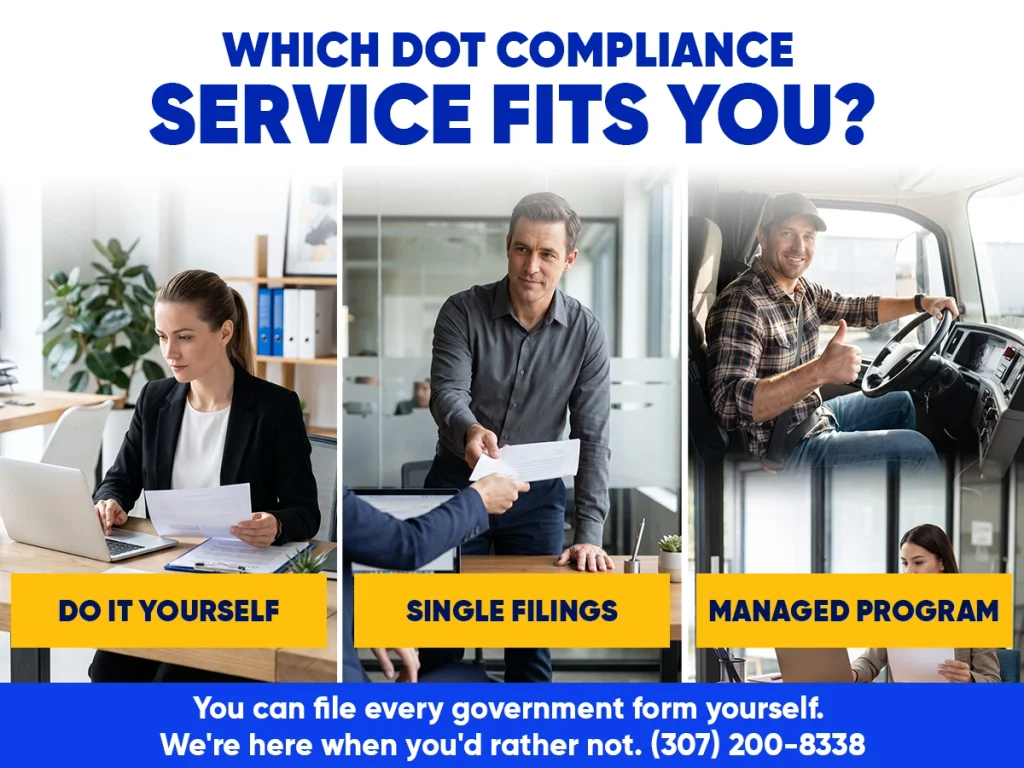
Which type of DOT compliance service fits you?
| Do it yourself | Single-filing services | Managed program | |
|---|---|---|---|
| Cost | Government fees only | Government fee + one service fee | Government fees + ongoing service fee |
| Your time | Highest | Medium | Lowest |
| Deadline tracking | You | You | Done for you |
| Error checking | You | On that filing only | Across your whole program |
| Best for | Experienced carriers with office time | Carriers who need one thing done right | New carriers and small fleets without a safety manager |
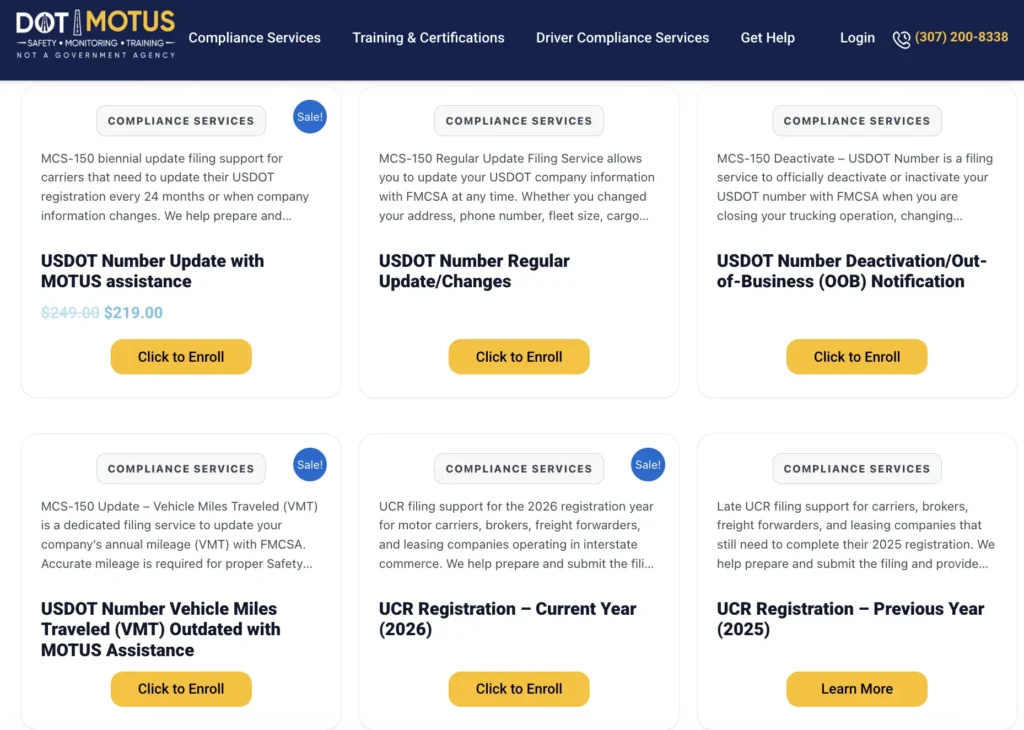
Our DOT filing and compliance services
| Need | Service | Format | Price |
|---|---|---|---|
| Biennial MCS-150 update in Motus | USDOT Number Update with Motus Assistance | Filed for you | $219 |
| UCR 2027 | UCR 2027 Filing | Filed in 24–36 working hours | $195–$525, state fee included |
| Missed UCR 2026 | UCR 2026 Filing | Filed for you | From $189 |
| Drug testing pool | Drug & Alcohol Random Testing | Consortium enrollment | See page |
| Clearinghouse setup and queries | Clearinghouse Compliance Services | Done for you | See page |
| Driver files | DQ File Setup | Built and reviewed | See page |
| IFTA and HVUT | IFTA Filing · Form 2290 | Filed for you | See page |
| Owner-operator duties | Owner-Operator D&A Training | Online, 75 min | $149 |
| Supervisors and DERs | Supervisor Training · DER Training | Online | $149 · $179 |
| Daily inspections | Pre-Trip, Post-Trip & DVIR Training | Online, 12 lessons | $129 |
Want us to run the whole thing? Read how our managed DOT compliance services work.
What we don’t do: we’re not FMCSA or any government agency, and we can’t promise a result at an audit or inspection. You stay responsible for running your operation safely and giving us accurate information. And you can always file directly with FMCSA, the UCR Plan, the IRS and your state yourself.
Ready to get it off your plate? See all our DOT compliance services, or call (307) 200-8338, Monday–Friday, 7 AM–7 PM Central.
FAQ
What is DOT compliance? DOT compliance means following FMCSA’s federal rules for commercial vehicles: registration, driver qualification, drug and alcohol testing, hours of service, vehicle maintenance and related tax filings. It applies to most vehicles over 10,001 lbs, certain passenger vehicles and placarded hazmat loads in interstate commerce.
What does a DOT compliance service do? A DOT compliance service files and tracks your federal and state requirements for you, such as UCR, MCS-150 updates, drug testing enrollment, Clearinghouse queries and driver files. It saves time and reduces mistakes, but it doesn’t replace your own legal responsibility to comply.
Do I need DOT compliance services, or can I do it myself? You can do every filing yourself on the official government sites, and many experienced carriers do. A service makes sense if you’re new, short on time, or have missed deadlines before.
What’s included in DOT management services? Managed DOT services usually cover deadline tracking, renewals (UCR, MCS-150), a random testing pool, Clearinghouse queries, driver qualification files and audit prep. What’s included varies, so ask for a written list before you sign up.
What is a DOT compliance program? It’s the written policies, records and calendar you use to meet every federal requirement: your drug and alcohol policy, driver files, logs, inspection reports and filing dates. Auditors check that the program exists and that you actually follow it.
How much do DOT compliance services cost? Government fees are set by each agency (for example, 2027 UCR starts at $55). Private service fees are added on top and vary by service; ours start at $119 for training and $189 for filings.
Is DOT compliance support available for brokers? Yes. Brokers need operating authority, a BOC-3, a financial security filing, UCR every year and MCS-150 updates. They don’t need driver or vehicle compliance unless they also run trucks.
What happens during a DOT audit? FMCSA reviews your drug and alcohol program, driver files, hours of service, vehicle maintenance, insurance and accident records. New carriers get a safety audit, usually within the first 12 months, and 16 specific violations fail it automatically.
Is the MCS-150 biennial update still required in 2026? The requirement still exists, but FMCSA has paused enforcement for updates due on or after June 1, 2026, while Motus stabilizes. It has promised advance warning before enforcement resumes.
Are DOT compliance companies part of the government? No. Private compliance companies, including DotMotusCompliance, are not FMCSA or DOT. Be careful of any site that implies it is official, and use fmcsa.dot.gov for government filings.
About this guide
DotMotusCompliance Inc. is an independent private company and is not a government agency or official government portal. This guide is for educational purposes; check the official sources below for current text.
Related guides: DOT drug and alcohol testing: the CDL driver guide · Who is exempt from UCR? · DOT roadside inspections preparedness guide · DER training guide
Government sources
- FMCSA Registration and Motus
- FMCSA: Temporary suspension of the biennial update requirement
- FMCSA: What would cause a carrier to fail a new entrant safety audit (49 CFR 385.321)
- 49 CFR 390.5: Definitions, including commercial motor vehicle
- 49 CFR 390.19: Motor carrier identification report (MCS-150)
- 49 CFR Part 382: Drug and alcohol testing
- 49 CFR Part 391: Driver qualification
- 49 CFR Part 395: Hours of service
- 49 CFR Part 396: Inspection, repair and maintenance
- 49 CFR 387.9: Minimum financial responsibility
- UCR Plan: 2027 fee brackets
- FMCSA Drug and Alcohol Clearinghouse
- IRS: About Form 2290