Owner-Operator Pre-Employment Drug Test: The Rule, the Myths and What to Do Before Your First Load
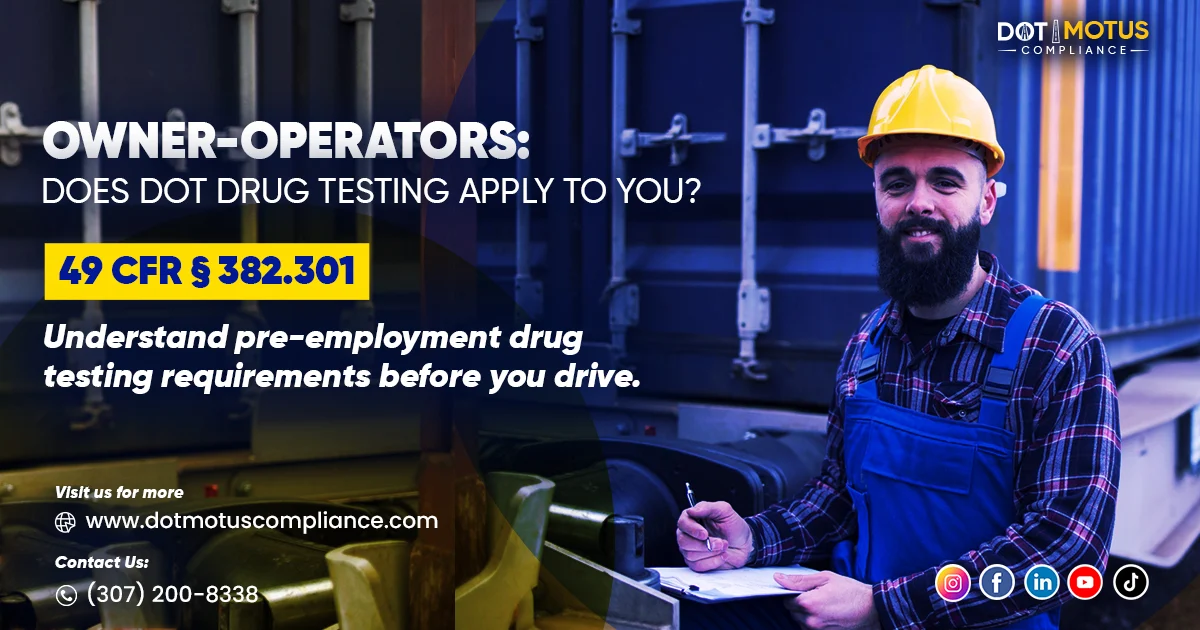
If you are an owner-operator about to run your first load under your own authority, you need a verified negative DOT pre-employment drug test before you turn the key. The rule is 49 CFR 382.301, and it applies to one-truck operations exactly the way it applies to fleets.
This guide works in three steps. First it explains the rule in plain English, then it clears up the myths that get new owner-operators in trouble, and then it gives you a checklist to finish before your first load. Every rule cited links to the official government source so you can check it yourself.
| Quick answer | |
|---|---|
| The rule | 49 CFR 382.301, pre-employment testing |
| Who it applies to | Any CDL driver about to perform safety-sensitive work, including owner-operators testing themselves |
| What you need | A verified negative DOT drug test result before your first safety-sensitive function |
| Who verifies it | A Medical Review Officer (MRO) |
| Alcohol test required? | No. Pre-employment alcohol testing is optional |
| Exceptions | Narrow; only if you were recently in another DOT testing program (explained below) |
| Also needed | A Clearinghouse pre-employment query and membership in a random testing pool |
Part 1: The rule, explained
What 382.301 says
Before a driver performs safety-sensitive functions for the first time, the driver must take a DOT controlled substances test. The employer may not let the driver work until it has received a verified negative result from the MRO or the consortium/third-party administrator (C/TPA) (49 CFR 382.301(a)).
Three words in that rule do the heavy lifting:
- Before. The result must be in hand before the first safety-sensitive function, not after.
- Verified. A Medical Review Officer reviews the lab result before it is final. A lab result alone is not enough.
- Negative. Anything else (positive, refusal, adulterated or substituted) means you cannot drive.
What counts as a safety-sensitive function
It is broader than driving. Under FMCSA rules it includes waiting to be dispatched, inspecting or servicing the truck, loading and unloading, and being in the truck except to rest in the sleeper (49 CFR 382.107). In practice, you cannot start any work tied to your first load until the result arrives.
Why it applies to you as an owner-operator
FMCSA’s drug and alcohol rules apply to every employer of CDL drivers, and the definition of employer includes a person who is self-employed as a driver (49 CFR 382.107). So when you get your own USDOT number and authority, you take on both roles. Every duty a fleet has toward its drivers, you now have toward yourself, starting with this test.
The drug test is required; the alcohol test is not
Pre-employment alcohol testing is optional. If you choose to do it, you must follow DOT procedures and test every driver the same way (49 CFR 382.301(d)). For a one-person company, most owner-operators skip it.
Part 2: How to complete it, step by step
Do these in order. Most owner-operators can finish them in a few business days.
- Join a consortium/third-party administrator (C/TPA). You need one anyway for random testing, and most C/TPAs schedule your pre-employment test as part of enrollment.
- Register in the Drug and Alcohol Clearinghouse twice: as an employer and as a driver. Then designate your C/TPA in your employer account. FMCSA requires owner-operators to designate a C/TPA there (49 CFR 382.705).
- Run the pre-employment full query on yourself. A full Clearinghouse query is required before any driver performs safety-sensitive functions (49 CFR 382.701). Approve the consent request in your driver account when it arrives.
- Take the DOT drug test at a collection site. Make sure the collector uses the federal Custody and Control Form. A test on a non-federal form is not a DOT test.
- Wait for the MRO-verified result. Negative results usually arrive within one to three business days. Do not drive, load or wait for dispatch in the meantime.
- File the result and the query record. Keep both in your drug and alcohol file. Auditors ask for them.
Only after step 6 can you take your first load.
Part 3: The exception, and why it rarely helps owner-operators
The rule lets an employer skip a new pre-employment test only if all of these are true (49 CFR 382.301(b)):
| Condition | What it means for you |
|---|---|
| You took part in a DOT drug testing program within the last 30 days | For example, you drove for a carrier until a few weeks ago |
| While in that program, you were tested in the last 6 months, or were in its random pool for the last 12 months | Measured from the date you start with the new employer, which here is your own company |
| No prior employer has a drug and alcohol violation on record for you in the last 6 months | No positives, refusals or other violations |
If you use the exception, you must also get written verification from the previous testing program: its name and address, proof you participated, proof it follows Part 40, the date of your last test and any results from the past six months (49 CFR 382.301(c)).
For most owner-operators the exception is more paperwork than it saves. A new test usually costs less than the time spent collecting verification, and it gives an auditor one clean document. When in doubt, test.
Part 4: Myths that get owner-operators in trouble
Myth 1: “I’m a one-truck operation, so the drug testing rules are for fleets.”
Fact: A self-employed driver is the employer under Part 382 (49 CFR 382.107). There is no size exemption. One truck, one driver, same rules.
Myth 2: “Any drug test from a local clinic works.”
Fact: It must be a DOT test, collected on the federal Custody and Control Form and verified by an MRO under 49 CFR Part 40. A workplace or court-ordered test on a non-DOT form does not satisfy 382.301.
Myth 3: “I took the test, so I can start hauling while the result comes back.”
Fact: The rule requires the verified negative result before the first safety-sensitive function (49 CFR 382.301(a)). Taking the test is not enough, and safety-sensitive work includes loading and waiting for dispatch, not just driving.
Myth 4: “My test from CDL school or my last driving job still counts.”
Fact: Only if you meet every condition of the exception in Part 3 and collect written verification from that program. If you left your last job more than 30 days ago, it cannot be used.
Myth 5: “I need a drug test and an alcohol test.”
Fact: Only the drug test is required. Pre-employment alcohol testing is optional (49 CFR 382.301(d)).
Myth 6: “I was leased to a carrier, so I’m already covered under my own authority.”
Fact: While you were leased, the carrier’s program covered you. When you switch to your own authority, your company is a new employer, so a new pre-employment test is required unless the exception applies.
Myth 7: “Marijuana is legal in my state, so it won’t matter.”
Fact: DOT rules do not recognize state marijuana laws. Marijuana use is prohibited for CDL drivers in safety-sensitive work, and a verified positive is a violation (DOT ODAPC notice).
Myth 8: “Once I pass pre-employment, I’m done with testing.”
Fact: Pre-employment is the first of several tests. You must also be in a random testing pool and complete post-accident and other tests when they apply (49 CFR 382.305).
Part 5: What happens if you get it wrong
At your new entrant safety audit
FMCSA audits every new carrier, usually within the first 12 months, and asks for your drug and alcohol records, including pre-employment results (FMCSA New Entrant Safety Assurance Program).
A missing pre-employment test is a violation the auditor will cite. It also tends to reveal bigger problems that are on FMCSA’s list of 16 automatic-failure violations (49 CFR 385.321), including:
- Failing to implement a drug and alcohol testing program at all
- Failing to implement a random testing program
- Using a driver who refused a required test
- Using a driver known to have tested positive
Any one of those fails the audit outright. A failed audit means a corrective action plan, and if it is not accepted, revocation of your new entrant registration.
If your result is positive or you refuse
You cannot perform safety-sensitive work. The violation is reported to the Clearinghouse, and you must complete the return-to-duty process with a Substance Abuse Professional (SAP), pass a return-to-duty test, and then complete follow-up testing before driving again. A refusal is treated the same as a positive.
| Mistake | Likely consequence |
|---|---|
| Driving before the verified negative result | Violation of 382.301 cited at audit or investigation |
| No testing program or random pool at all | Automatic audit failure |
| Non-DOT test used | Treated as no pre-employment test |
| Positive result or refusal | Removed from duty; Clearinghouse report; SAP and return-to-duty process |
Part 6: Before-your-first-load checklist
Print this or save it to your phone. Every box should be checked before you accept your first load.
- Enrolled with a C/TPA and placed in its random testing pool
- Registered in the Clearinghouse as an employer and as a driver
- C/TPA designated in your Clearinghouse employer account
- Pre-employment full Clearinghouse query completed, with consent given
- DOT drug test taken on the federal Custody and Control Form
- MRO-verified negative result received
- Written drug and alcohol policy in place
- Result, query record and policy filed in your drug and alcohol records
- If using the 382.301(b) exception: written verification from the previous program on file
Part 7: The complete solution
The pre-employment test is the first duty you take on as an owner-operator, not the last. The same Part 382 rules also cover random testing, Clearinghouse queries every year, post-accident testing, refusals, return-to-duty and recordkeeping. Learning them one violation at a time is the expensive way.
Our Owner-Operator DOT Drug & Alcohol Compliance Training walks you through the full set of duties in one sitting:
| What you get | Details |
|---|---|
| Format | Online, self-paced, 75 minutes |
| Covers | Your role as employer and driver, when testing is required, working with a C/TPA, Clearinghouse duties, refusals and violations, recordkeeping |
| Assessment | 15-question knowledge check; 80% to pass |
| Certificate | Yes, on completion |
| Bonus | Owner-Operator Mini-Compliance Binder: 10 tabs of logs and templates, including a pre-employment log, Clearinghouse query log, random testing log and audit checklist |
| Price | $149 |
| Who it fits | Owner-operators under their own authority, drivers moving from leased to own authority, and fleets of 1–5 drivers |
To be clear about what it is: the course teaches you the rules and gives you the records system. It does not enroll you in a testing pool or run your Clearinghouse queries; you still contract with a C/TPA for those.
Enroll in the Owner-Operator Compliance Training or call (307) 200-8338, Monday–Friday, 7 AM–7 PM Central, with questions.
FAQ
How long does a DOT pre-employment drug test take? The collection takes minutes. A verified negative result usually arrives within one to three business days.
Can I drive my own truck while waiting for the result? No. Not driving, loading or waiting for dispatch, until the verified negative result is in hand.
Who pays for an owner-operator’s pre-employment test? You do, as the employer. Many C/TPAs include it in their enrollment package.
Do I need a new test if I switch from leased to my own authority? Yes, unless you meet every condition of the 382.301(b) exception and collect written verification.
Is the Clearinghouse query separate from the drug test? Yes. Both are required before your first safety-sensitive function.
About this guide
DotMotusCompliance is a private transportation compliance and training company, not FMCSA, USDOT or a government agency. This guide explains federal rules for educational purposes; always check the official sources below for the current text.
Government sources
- 49 CFR 382.301: Pre-employment testing
- 49 CFR 382.107: Definitions, including employer and safety-sensitive function
- 49 CFR 382.305: Random testing
- 49 CFR 382.701: Clearinghouse queries
- 49 CFR 382.705: Reporting to the Clearinghouse
- 49 CFR 385.321: New entrant automatic-failure violations
- 49 CFR Part 40: DOT testing procedures
- FMCSA Drug and Alcohol Clearinghouse
- FMCSA New Entrant Safety Assurance Program
- DOT ODAPC: Recreational marijuana notice
“DotMotusCompliance Inc. provides transportation compliance, safety and training support for motor carriers, owner-operators, fleets and transportation businesses across the United States.
Our services support businesses throughout their compliance lifecycle, including DOT and Non-DOT drug & alcohol programs, C/TPA services where applicable, driver qualification file (DQF) management, driver screening and pre-employment compliance, safety and fleet compliance, training, recordkeeping, monitoring, and regulatory filing assistance.
DMC helps transportation businesses organize compliance responsibilities, manage required documentation, coordinate applicable services and maintain more efficient compliance processes. Certain services may involve government agencies, regulatory programs, official databases or third-party providers. DotMotusCompliance Inc. is an independent private company and is not a government agency or official government portal.