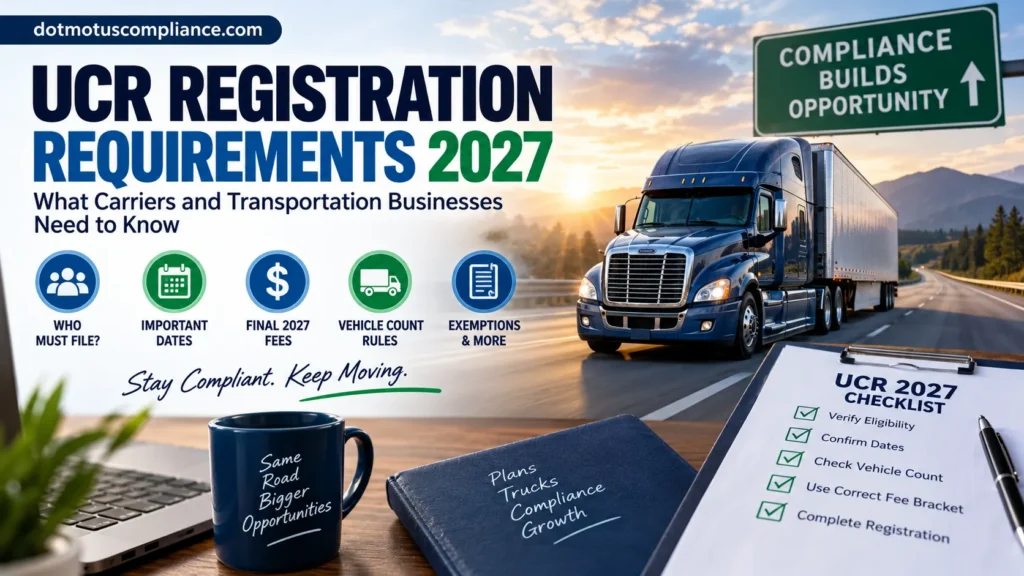
UCR Registration Requirements 2027: Who Must Register, How to Count Vehicles, and What to Check
If your business is a motor carrier, motor private carrier of property, broker, freight forwarder, or leasing company involved in interstate or international commerce, the UCR registration requirements for 2027 are straightforward: register for the 2027 year through your base state, pay the 2027 fee for your bracket, and finish before January 1, 2027. The official 2027 registration portal opens October 1, 2026 (UCR Plan), and the new government fees run from $55 to $54,165 (Federal Register, 91 FR 56063).
Carriers pay according to the number of commercial motor vehicles they count. Brokers and leasing companies pay the lowest fee. And because UCR is an annual requirement, a 2026 registration does not carry over into 2027.
Key facts: 2027 UCR requirements at a glance
| Requirement | What applies for 2027 | Source |
|---|---|---|
| Who must register | Interstate or international motor carriers (for-hire and private property carriers), for-hire passenger carriers, brokers, freight forwarders, and leasing companies | UCR Plan eligibility questionnaire; 91 FR 56063 |
| Registration opens | October 1, 2026, in the National Registration System | UCR Plan |
| Complete by | Before January 1, 2027 | UCR Plan |
| After January 1, 2027 | The fee is still due, and a business that has not registered may face state enforcement action | UCR Plan |
| 2027 government fee | $55 (0–2 vehicles, and all brokers and leasing companies) up to $54,165 (1,001+ vehicles) | 49 CFR 367.50, 91 FR 56063 |
| What the fee is based on | Entity type and number of commercial motor vehicles (power units, not trailers) | UCR Plan FAQ |
| Where to register | The UCR Plan’s National Registration System at ucr.gov, through your base state | UCR Plan |
| Proof in the truck | No credential is required; carrying your receipt is optional | UCR Plan FAQ |
What UCR Registration Requires (and What It Doesn’t)
Unified Carrier Registration (UCR) is an annual registration and fee program established by federal law at 49 U.S.C. 14504a (UCR Plan FAQ). The UCR Plan, an organization of state, federal, and industry representatives, administers it. The fees are collected on behalf of the 41 participating states and must be used for motor carrier safety programs, enforcement, or administering the program (91 FR 56063).
What the requirement asks of you:
- One registration per business, per year. You register the company, not individual trucks.
- A fee set by your business type and vehicle count. The fee does not change based on how many states you operate in or which state is your base state (UCR Plan FAQ).
- Registration through a base state. A base state is the single participating state you register and pay through, which collects on behalf of all participating states. If your principal place of business is in a participating state, that state is your base state. If it isn’t, the UCR Plan’s hierarchy directs you to a state where you have an office or operating facility, or to a designated regional option (UCR Plan FAQ). Our 2026 guide lists the base-state options for businesses in non-participating states.
What the requirement does not ask of you:
- No decal, cab card, or credential in the vehicle. You may carry your payment receipt if you choose (UCR Plan FAQ).
- No mid-year refiling when your fleet changes. Increases or decreases during the year are reflected in the next registration year (UCR Plan FAQ).
- It does not replace other registrations. UCR is separate from your USDOT number, operating authority, biennial update, IRP, and IFTA. FMCSA sets the UCR fee levels through rulemaking, but you register in the UCR Plan’s National Registration System. FMCSA’s own registration system, Motus, is where registrants manage USDOT numbers, operating authority, biennial updates, and business information changes (FMCSA).
UCR Registration Requirements 2027: Who Must Register
UCR applies to five kinds of businesses when they operate in interstate or international commerce.
| Business type | Must register for 2027 if it… | How the 2027 fee is set |
|---|---|---|
| For-hire motor carrier (property) | Transports property for compensation in interstate or international commerce, including exempt commodities (UCR Plan FAQ) | By vehicle-count bracket |
| Motor private carrier of property | Moves its own goods interstate to support its main line of business (UCR Plan forms) | By vehicle-count bracket |
| For-hire passenger carrier | Transports passengers interstate and charges for it, either directly (tickets) or bundled into another service such as a hotel or camp shuttle (UCR Plan eligibility questionnaire) | By vehicle-count bracket |
| Broker | Arranges interstate transportation | Lowest bracket ($55), set by statute (91 FR 56063) |
| Freight forwarder | Provides interstate freight forwarding | Lowest bracket if it operates no vehicles; by vehicle-count bracket if it does (UCR Plan FAQ) |
| Leasing company | Leases or rents vehicles without drivers, for compensation, to motor carriers, motor private carriers, or freight forwarders (49 U.S.C. 14504a(a)(4)) | Lowest bracket ($55) |
The interstate commerce test
The question is not only whether your truck crosses a state line. The UCR Plan’s eligibility questionnaire also asks whether the property or passengers cross a state or national border at any point in their journey, including before you pick them up or after you deliver them. Hauling goods to a port or airport is the common example (UCR Plan eligibility questionnaire).
In practice, a truck that never leaves Texas can still be operating in interstate commerce if the freight it carries arrived from, or is headed to, another state or country.
Situations that do not remove the requirement
- Hauling only your own property, equipment, or tools. The UCR Plan notes this does not exempt you (UCR Plan eligibility questionnaire).
- Operating only light vehicles. A business with federal operating authority that runs only vehicles under the commercial motor vehicle threshold generally still registers, typically at the lowest fee (UCR Plan eligibility questionnaire, citing the UCR Handbook).
- Having your operating authority revoked. The UCR Plan states the carrier remains subject to the UCR Agreement (UCR Plan FAQ).
- Being based in a non-participating state. You still select a base state and pay the same fee as everyone else in your bracket (UCR Plan FAQ).
- Not owning trucks. Brokers and leasing companies register even without a fleet.
Who generally does not need to register
According to the UCR Plan’s questionnaire, the following are not required to register: operations engaged only in intrastate commerce; private carriers of passengers, such as churches, schools, and businesses transporting their own employees; and operations running solely federal government vehicles, solely emergency vehicles, or solely within Hawaii (UCR Plan eligibility questionnaire).
These exceptions are narrower than many carriers assume. Before relying on one, read our guide to who is exempt from UCR registration and use the official UCR “Do I Need to Register?” questionnaire.
How to Count Vehicles for Your 2027 UCR Fee
For carriers and freight forwarders that operate vehicles, the vehicle count is the requirement most often gotten wrong, and it directly sets your fee.
Step 1: Count only commercial motor vehicles (power units)
For UCR purposes, a commercial motor vehicle (CMV) is a self-propelled vehicle used on highways in commerce mainly to transport passengers or cargo that meets at least one of these tests (UCR Plan FAQ):
- A gross vehicle weight rating or gross vehicle weight of at least 10,001 pounds, or at least 10,001 pounds combined when connected to trailing equipment
- Carries placarded amounts of hazardous materials, regardless of weight
- Designed to carry more than 10 passengers, including the driver
Trailers are not counted as separate vehicles (Connecticut DMV UCR instructions). However, if a lighter power unit pulls a trailer and the combination reaches 10,001 pounds or more, that power unit counts (UCR Plan eligibility questionnaire).
Step 2: Choose your counting method
State UCR agencies describe two ways to determine the count (Missouri DOT UCR instructions; Minnesota DOT UCR form):
| Method | What you count | For the 2027 registration year |
|---|---|---|
| Option A | The number of CMVs reported on your most recent MCS-150 (your USDOT registration update) | Your latest filed count |
| Option B | The number of CMVs you owned or operated during the 12-month period ending June 30 of the year before the registration year | July 1, 2025, through June 30, 2026 |
Leased vehicles: Vehicles you operate under leases of more than 30 days are included in the count (Missouri DOT UCR instructions). Vehicles operated only under short-term leases are not (Minnesota DOT UCR form).
Recordkeeping for Option B: If Option B places you in a lower bracket than Option A would, you must keep a list of the vehicles covered and provide it to your base state on Form UCR-2 if asked (UCR Plan forms).
Step 3: Subtract qualifying intrastate-only vehicles (optional)
You may subtract a vehicle used exclusively in intrastate transportation, but only if all three of these conditions are true during the registration year (UCR Plan forms):
- The vehicle did not, and will not, travel outside the state.
- The vehicle did not, and will not, carry property, waste, or recyclable material that came from outside the state or is headed outside the state.
- The vehicle is not registered under the International Registration Plan (no apportioned plate).
If you subtract vehicles, keep a list of them and provide it on Form UCR-1 if your base state requests it. Passenger vehicles cannot be listed on Form UCR-1 (UCR Plan forms). Separately, a carrier primarily engaged in intrastate school-bus operations may leave its intrastate school buses out of the fleet count (UCR Plan eligibility questionnaire).
Because the conditions cover the whole registration year, a truck you subtract for 2027 should stay out of interstate work for all of 2027.
Step 4: Match your total to the 2027 bracket
These examples show how the rules above play out. They are illustrations, not a determination for your business.
| Situation | Countable CMVs | 2027 bracket | 2027 fee |
|---|---|---|---|
| Owner-operator with 1 tractor and 2 trailers | 1 | B1 (0–2) | $55 |
| Freight broker with no vehicles | Not applicable | Broker rate | $55 |
| Company with 3 box trucks rated at 12,000 lbs, plus 2 cargo vans under 10,000 lbs that never tow trailers or carry placarded hazmat | 3 | B2 (3–5) | $167 |
| Carrier with 21 power units, one of which meets all three intrastate-only conditions and is documented for Form UCR-1 | 20 | B3 (6–20) | $333 |
| The same carrier, if that truck does not meet all three conditions | 21 | B4 (21–100) | $1,163 |
Want a second set of eyes on your classification or fleet count? Private filing assistance is available, and we explain both options below.
2027 UCR Fees and Key Dates
FMCSA finalized the 2027 fees on September 1, 2026, effective October 1, 2026. They average about 20% higher than the fees used for 2025 and 2026, with increases of $9 to $9,329 depending on the bracket. The 2027 schedule stays in effect for later years unless a future rulemaking changes it (91 FR 56063).
2027 UCR fee table
| Category | Applicable year | Fee | Who it applies to | Source |
|---|---|---|---|---|
| Bracket B1: 0–2 CMVs | 2027 | $55 | Carriers and freight forwarders with 0–2 CMVs; all brokers and leasing companies | 49 CFR 367.50 (91 FR 56063) |
| Bracket B2: 3–5 CMVs | 2027 | $167 | Carriers and freight forwarders with 3–5 CMVs | 49 CFR 367.50 |
| Bracket B3: 6–20 CMVs | 2027 | $333 | Carriers and freight forwarders with 6–20 CMVs | 49 CFR 367.50 |
| Bracket B4: 21–100 CMVs | 2027 | $1,163 | Carriers and freight forwarders with 21–100 CMVs | 49 CFR 367.50 |
| Bracket B5: 101–1,000 CMVs | 2027 | $5,548 | Carriers and freight forwarders with 101–1,000 CMVs | 49 CFR 367.50 |
| Bracket B6: 1,001+ CMVs | 2027 | $54,165 | Carriers and freight forwarders with 1,001 or more CMVs | 49 CFR 367.50 |
These amounts are government fees only. For more on how the brackets work, see our 2027 UCR fee brackets overview.
Filing for 2026 instead? The 2026 registration year uses a different schedule, running from $46 to $44,836 (UCR Plan). Never apply one year’s fee to another year’s registration.
A note on the legal challenge: A small-business coalition asked a federal appeals court to halt the 2027 fee increase. The D.C. Circuit denied that motion on June 17, 2026, and FMCSA finalized the rule (91 FR 56063). Check the UCR Plan fee page before you pay in case anything changes.
Key 2027 dates
| Date | What happens | Source |
|---|---|---|
| October 1, 2026 | 2027 fees took effect, and the 2027 registration portal opened in the National Registration System | 91 FR 56063; UCR Plan |
| Before January 1, 2027 | Complete 2027 registration and payment to keep operating legally | UCR Plan |
| January 1, 2027, onward | The 2027 fee is still due, and businesses that have not registered may face state enforcement action | UCR Plan |
UCR Renewal Requirements: What to Recheck Every Year
There is no automatic UCR renewal. Each registration year is separate, so the full set of requirements applies again every year (UCR Plan). When people search for UCR renewal requirements, this is what they actually need to recheck before registering for a new year.
| What to recheck | Why it can change | What to do for 2027 |
|---|---|---|
| Registration year | Collections for different years overlap, so more than one year can be available at once (91 FR 56063) | Confirm you are paying for 2027, and handle any unpaid earlier year separately |
| Fee schedule | The 2027 fees are new | Use the 2027 table, not last year’s amount |
| Vehicle count | Your fleet may have grown, shrunk, or changed leases, and Option B uses a new 12-month window | Recount using your MCS-150 figure or the period ending June 30, 2026 |
| Business type | You may have started brokering, forwarding, or leasing, or stopped hauling | Rerun the eligibility questions for each role |
| Base state | You may have moved your principal place of business or opened a facility | Reapply the base-state rules (UCR Plan FAQ) |
| USDOT registration record | FMCSA expects timely updates when your name, address, or other details change, plus an update every two years (UCR Plan) | Make needed updates in FMCSA’s Motus system before filing (FMCSA) |
| Intrastate subtractions | A truck that took interstate work no longer qualifies | Review your Form UCR-1 list against the three conditions |
| Records | Your base state can request your vehicle lists | File your receipt, counting method, and any UCR-1 or UCR-2 lists by year |
If you already know what is required and want a screen-by-screen walkthrough, see our guide to complete UCR renewal online for 2027.
If an earlier year is still unpaid
Registering for 2027 does not cover a missed 2026 or 2025 year. FMCSA explains that collections for each registration year begin October 1 of the year before and close December 31 of the year after, which leaves room for late registrations and dispute resolution (91 FR 56063). Under that timeline, the 2025 collection window runs through December 31, 2026, and the 2026 window runs through December 31, 2027. Confirm availability in the National Registration System before you rely on those dates.
If your business still needs to handle an earlier year, you can register directly or see UCR Registration – Current Year (2026) or UCR Registration – Previous Year (2025).
How to Meet the 2027 UCR Requirements, Step by Step
This is the order that prevents the most rework. Each step lists what to do, why it matters, and what to check.
1. Confirm UCR applies to your business
What to do: Identify every role your business plays (carrier, broker, forwarder, leasing company) and apply the interstate commerce test to your actual freight or passengers. The official UCR questionnaire walks through it.
Why it matters: Both the obligation and the fee depend on your business type.
What to check: Whether any load crosses a state or national border at any point in its journey, and whether an exception truly applies rather than one you assumed.
2. Update your USDOT registration record first
What to do: If your legal name, DBA, address, or fleet details have changed, or your biennial update is due, update your record in Motus before filing UCR.
Why it matters: The UCR Plan’s vehicle-list forms ask for owner and DBA names that match what is on file for your USDOT number (UCR Plan forms). Mismatched records can cause confusion if your base state reviews your filing.
What to check: Compare your company details on FMCSA’s SAFER Company Snapshot with the information you plan to enter.
3. Count your commercial motor vehicles
What to do: Choose Option A or Option B, count power units only, and subtract any vehicles that meet all three intrastate-only conditions.
Why it matters: Your count sets your bracket, and the difference between brackets can be hundreds or thousands of dollars.
What to check: No trailers in the count, leased vehicles over 30 days included, and a vehicle list kept if you used Option B to lower your bracket or subtracted intrastate vehicles.
4. Identify your base state
What to do: Use your principal place of business if it is in a participating state. If not, follow the UCR Plan’s base-state hierarchy (UCR Plan FAQ).
Why it matters: UCR is a base-state system; your registration and fee go through that state.
What to check: Whether you moved or opened a facility since your last registration.
5. Register and pay in the National Registration System
What to do: On or after October 1, 2026, go to ucr.gov, select the 2027 registration year, enter your information, and pay before January 1, 2027.
Why it matters: Registering before January 1 of the registration year is what keeps your operation legal for that year (UCR Plan).
What to check: The year shows 2027, the bracket matches your count, and the fee matches the 2027 table. Questions go to the UCR help desk at 1-833-827-7526 or [email protected] (UCR Plan).
6. Save your confirmation and supporting records
What to do: Keep your receipt, a note of your counting method, and any UCR-1 or UCR-2 vehicle lists in a folder for that registration year.
Why it matters: Your base state may ask for vehicle lists (UCR Plan forms), and next year’s renewal is faster when last year’s records are organized.
What to check: That the saved receipt shows the correct year, business name, and amount.
Why some businesses choose help with this
The steps are manageable for a single-truck operator or a broker with a current USDOT record. They take more care when a fleet has leased units, mixed intrastate and interstate trucks, more than one business role, or an earlier year left unpaid. Some office teams also simply prefer to hand off one more annual filing alongside IFTA, IRP, and biennial updates. That is where private filing assistance can be useful. It is optional, and the section below explains exactly what it does and does not do.
Common Mistakes and a Before-You-File Checklist
Common mistakes
| Mistake | What goes wrong | How to avoid it |
|---|---|---|
| Counting trailers | Places you in a higher bracket than necessary | Count power units only |
| Using last year’s fee | The amount won’t match the 2027 schedule | Use the 2027 fee table |
| Paying 2027 while 2026 is still unpaid | The earlier year remains outstanding | Check each registration year separately |
| Assuming “intrastate” because trucks stay in one state | The freight may still be moving in interstate commerce | Look at the full journey of the load |
| Subtracting intrastate trucks without meeting all three conditions | The lower count may not hold up if your base state asks for your vehicle list | Confirm every condition and keep a Form UCR-1 list |
| Using Option B to drop a bracket without records | You cannot support the count if your base state requests it | Keep a Form UCR-2 vehicle list |
| Filing with an outdated USDOT record | Names or addresses don’t line up across records | Update your record in Motus first |
| Assuming brokers or leasing companies are exempt | A covered business goes unregistered | Register at the $55 rate |
| Waiting until the last week of December | No time left to fix a record or count problem | Start after October 1 once your information is confirmed |
Before-you-file checklist for 2027
- UCR applies to my business based on its actual operations
- I know every business role I operate under (carrier, broker, forwarder, leasing company)
- My USDOT record (name, DBA, address, fleet details) is current
- I chose Option A or Option B and know which one I used
- My count includes power units only, with long-term leased vehicles included
- Any intrastate-only subtraction meets all three conditions, with a list kept
- My total matches the correct 2027 bracket
- I know my base state
- I am registering for 2027, and any unpaid earlier year is being handled separately
- I will save my receipt and vehicle records in my 2027 folder
File It Yourself or Use Private Filing Assistance
You are never required to use a private company to register for UCR. Both options below lead to the same official registration.
Option 1: Register directly through the official system
Where: The UCR Plan’s National Registration System at ucr.gov. The 2027 portal opened October 1, 2026 (UCR Plan).
What you’ll need:
- USDOT number (if you have one)
- Legal business name and any DBA, matching your USDOT record
- Principal place of business address
- Business type or types
- Your commercial motor vehicle count and the method you used
- A way to pay the government fee
What to verify: Registration year, business identity, bracket, fee amount, and base state before you submit.
Who may prefer this: Owner-operators and small fleets with a simple count and a current USDOT record, and brokers or leasing companies paying the flat $55 rate.
Where to get official help: UCR help desk, 1-833-827-7526 or [email protected] (UCR Plan).
Option 2: Use private filing assistance
What assistance can simplify: Working through classification questions, reviewing the fleet count against the right bracket, selecting the base state, and handling the submission and confirmation so your team doesn’t have to.
What DotMotusCompliance handles for 2027 (service page):
- Preparing and submitting your 2027 UCR filing
- Verifying your carrier or business classification
- Reviewing your fleet size for the correct fee tier
- Selecting the correct state for your registration
- Sending email confirmation and your UCR receipt
- Helping with corrections if needed
How it works: You enroll, provide your USDOT number, fleet size, and business type through a secure questionnaire, and DotMotusCompliance files your registration and emails your confirmation. The government UCR fee and DotMotusCompliance’s service fee are shown separately at checkout (DotMotusCompliance 2026 UCR guide). The official 2027 portal opened October 1, 2026, so filings are submitted as soon as they are prepared.
What you remain responsible for: Providing accurate business, operation, and fleet information; keeping your USDOT record current with FMCSA; and making sure any vehicle lists you rely on are accurate.
Who may prefer this: Fleets with leased units or mixed intrastate and interstate trucks, businesses with more than one role, companies catching up on an earlier year, and office teams that would rather not manage another annual filing.
Disclosure: DotMotusCompliance is a private compliance assistance provider that charges a service fee. It is not FMCSA, USDOT, the UCR Plan, a state agency, or any government agency, and it is not affiliated with or endorsed by any of them. Eligible businesses can register directly through the official UCR system at ucr.gov without using a private service.
FAQs
What are the UCR registration requirements for 2027?
If your business operates in interstate or international commerce as a motor carrier, motor private carrier of property, for-hire passenger carrier, broker, freight forwarder, or leasing company, you must register for the 2027 year through your base state and pay the 2027 fee for your bracket before January 1, 2027 (UCR Plan).
When does 2027 UCR registration open?
The 2027 registration portal in the National Registration System opens October 1, 2026 (UCR Plan).
What happens if I register after January 1, 2027?
The fee is still due, but a business that has not registered by then may be subject to state enforcement action (UCR Plan).
How much does UCR cost for 2027?
Government fees range from $55 for 0–2 commercial motor vehicles to $54,165 for 1,001 or more. Brokers and leasing companies pay $55 (49 CFR 367.50, 91 FR 56063).
Does UCR renew automatically?
No. Each registration year is separate, so you register and pay again every year, rechecking your vehicle count, business type, base state, and the current fee schedule.
Do I need UCR if my trucks never leave my state?
Possibly. If the freight or passengers you carry cross a state or national border at any point in their journey, such as goods moving to or from a port, the UCR Plan treats that as interstate commerce (UCR Plan eligibility questionnaire). See our guide to who is exempt from UCR registration before assuming you’re exempt.
Do trailers count toward my UCR vehicle count?
No. UCR counts power units that meet the commercial motor vehicle definition (UCR Plan FAQ). A lighter power unit does count if it pulls a trailer and the combined weight rating reaches 10,001 pounds or more (UCR Plan eligibility questionnaire).
Do brokers and leasing companies need UCR in 2027?
Yes, if they operate in interstate commerce. Both pay the lowest fee, which is $55 for 2027, regardless of size (91 FR 56063).
I didn’t register for 2026. Does my 2027 registration cover it?
No. Each year is a separate registration and fee. Handle the 2026 year on its own, either directly through the official system or with assistance.
Do I have to use a private service, and do I need proof in my truck?
No to both. Eligible businesses can register directly at ucr.gov, and no UCR credential is required in the vehicle, though you can carry your receipt if you like (UCR Plan FAQ). DotMotusCompliance is an optional private service for businesses that prefer help.
Need Help With Your 2027 UCR Registration?
If you’ve determined that UCR applies to your business but would prefer assistance preparing and submitting the filing, DotMotusCompliance can help you complete the 2027 registration process.
Start 2027 UCR Registration → Call (307) 200-8338DotMotusCompliance is a private, for-profit compliance assistance provider. We are not FMCSA, USDOT, the UCR Plan, a state agency or another government agency. Businesses are not required to use a private filing provider and may register directly through the official UCR system.
Final CTA
Need help with your 2027 UCR registration?
DotMotusCompliance can assist businesses that prefer help preparing and submitting their UCR filing, including reviewing business classification and fleet size for the correct 2027 fee tier.
Primary service: UCR Registration – Current Year (2027)
Phone: (307) 200-8338 Email: [email protected] Hours: Monday–Friday, 7 AM–7 PM Central Time Address: 202 N Cedar Ave Ste #1, Owatonna, MN 55060
Prefer to do it yourself? Eligible businesses can register directly through the official UCR National Registration System at ucr.gov. Meeting the UCR registration requirements for 2027 comes down to confirming UCR applies, counting your vehicles correctly, using the 2027 fee schedule, and registering before January 1, 2027, whichever route you choose.
DotMotusCompliance is a private compliance assistance provider. It is not FMCSA, USDOT, the UCR Plan, a state agency, or a government agency.
Ucr Registration Requirements brief video watch it for better understanding
Sources
- Federal Register, Fees for the Unified Carrier Registration Plan and Agreement, 91 FR 56063 (September 1, 2026)
- FMCSA rule summary page for FR Doc. 2026-17893
- UCR Plan, Fee Brackets
- UCR Plan, Frequently Asked Questions
- UCR Plan, “Do I Need to Register?” questionnaire
- UCR Plan, Registration Forms (UCR-1 and UCR-2)
- 49 U.S.C. 14504a (Office of the Law Revision Counsel, U.S. House of Representatives)
- FMCSA, “Move into Motus”
- Missouri Department of Transportation, UCR registration instructions (state UCR agency)
- Minnesota Department of Transportation, UCR registration form (state UCR agency)
- Connecticut Department of Motor Vehicles, UCR form instructions (state UCR agency)
- UCR National Registration System
- FMCSA SAFER Company Snapshot